Emile Louis Ligard Billon: A French Artist in Colonial India (c.1799-1873)
Fourth great grandfather to Patience Jewell Whitty
Emile Louis Ligard Billon was born in France around 1799—likely in the last turbulent years of the French Revolution or the earliest years of Napoleon's ascent. By 1817 he had made his way to India, arriving as an eighteen-year-old at the height of British expansion in Bengal. His origins are otherwise a blank: no known parents, no clear reason recorded for why a young Frenchman crossed the world to the East India Company's territories so soon after the end of the Napoleonic Wars.
Yet his arrival fits a familiar pattern of the era; peace in Europe after 1815 sent many young men—soldiers without wars to fight, artists without patrons, adventurers without prospects—searching for opportunity in Company India, where a growing colonial society of merchants, officials, and military officers created steady demand for portraitists, surveyors, and skilled tradesmen regardless of their nationality.
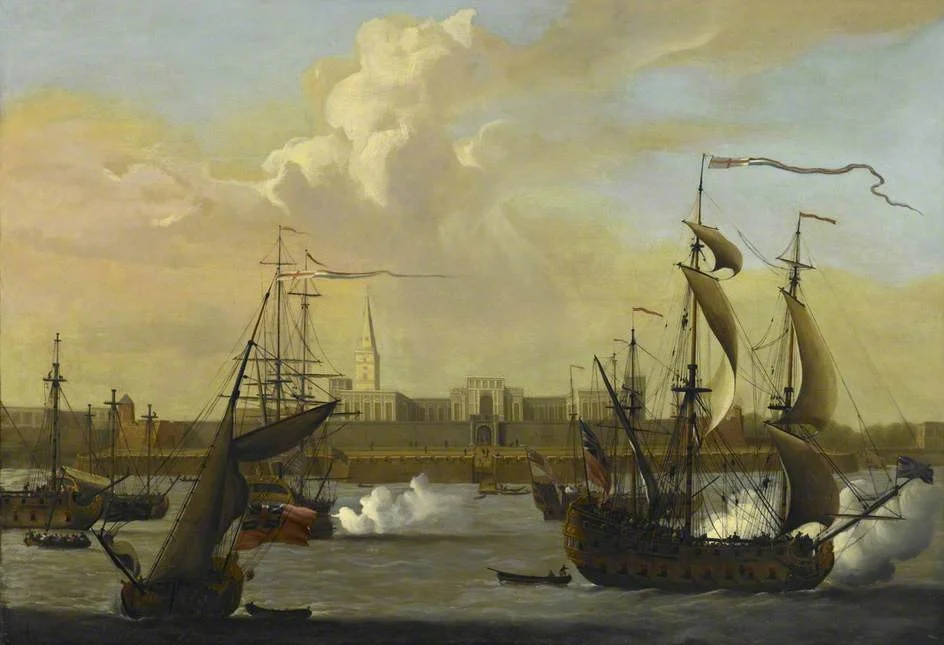
Fort William, Calcutta, George Lambert, 1731.
Billon found his niche in an emerging technology: lithography. Printing images from a flat stone using oil-based ink, this technique had only been invented in Germany in 1796 and was still a novelty when Emile began working with it in Calcutta in the 1820s.
He is remembered as the first lithographer credited by name in an illustrated Indian book, and he ran some of the subcontinent's earliest commercial lithographic presses.
His best-documented work, a set of views titled Twelve Select Views of the Seat of War, depicted the First Anglo-Burmese War of 1824–26—Britain's first major military campaign in Southeast Asia and a conflict that, though costly, marked the beginning of British Burma.
That Billon was producing illustrated visual reportage on this war within a year of its outbreak reflects how quickly the young printing trade in Calcutta had begun to serve the colonial public's appetite for images of imperial events, well before photography existed to do the same job.
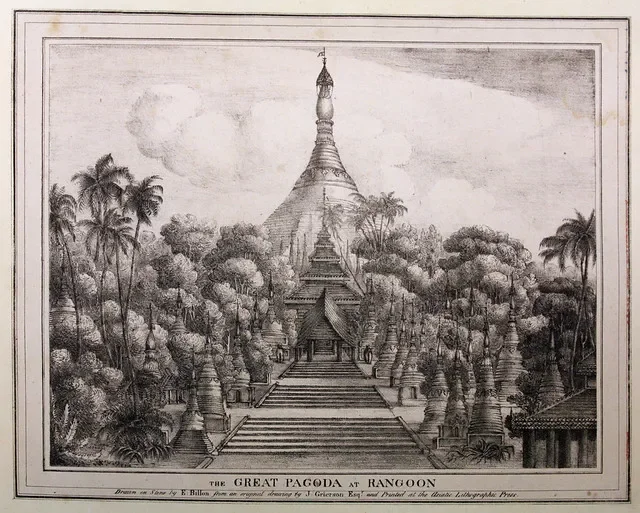
The Great Pagoda at Rangoon, Printed on stone by Emile Billon at the Asiatic Lithographic Press.
His personal life was shaped by the demographic realities of European colonial society in India, where climate, disease, and childbirth took a heavy toll. The rapid succession of marriages, each following closely on a wife or husband's death, was not unusual among Europeans in India during this period. Swift remarriage was often less a matter of haste than of practical necessity for a spouses managing a household and children in a foreign land.
On 15 June 1825, at St John's Cathedral in Calcutta, Emile married Martha Cumberland, daughter of a Master of Artillery at Fort William in Calcutta. Martha was only thirteen years old at the time of her marriage—a reminder of how young Eurasian girls in colonial India married, given the shortage of eligible women in Company society.

St John's Cathedral, Calcutta, hand-colored photographic print by Frederick Fiebig, dated 1851.
Martha and Emile had at least three children together: Emilia, born in 1826, who went on to marry into the Olliver family of Anglo-Indian surveyors and became the ancestress of a long line of descendants (Hampton, Olliver, Ewart, Kerr); Julia Anne Eliza, born in 1829, who married a Terry (likely a relation to Joseph Olliver’s second wife, Mary Terry); and a third child, a daughter born in Monghyr in 1831, whose name was never recorded. Martha herself died in 1833, age about twenty-two.
Nineteen months later, in December 1834, Emile married Charlotte Eliza Martin in Allahabad. His marriage record listed his profession simply as ‘Artist.’ That marriage, too, was brief; Charlotte died within a few years, leaving no recorded children.
Nine months after her death, in September 1837, Billon married a third time, to Harriet Sarah Adels, in Agra. With Harriet he had at least two more children: Benjamin Henry, born in 1838, who later fathered children of his own in India (Henrie Emile, Mary Louise Julie, Benjamin, and Bruce Horace); and Louisa, born in 1840, who married a Clarke.
Across three marriages and roughly fifteen years Billon fathered at least five children who lived to adulthood, planting a family line that spread through the Olliver, Terry, and Clarke surnames across colonial Bengal and beyond.
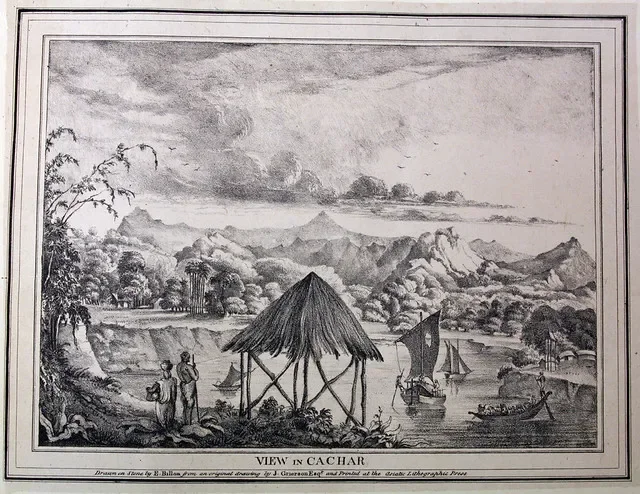
View in Cachar, in the present-day Indian state of Assam. Printed on Stone by Emile Billon at the Asiatic Lithographic Society.
Billon's own career, meanwhile, tracked the shifting geography of the British presence in northern India. He worked in Howrah and Monghyr as a miniature painter, then appears in Allahabad and Agra by the mid-1830s—towns tied to the expanding administrative and military infrastructure of the Bengal Presidency.
His final years found him in Dera Ismael Khan, now in Pakistan, on the North-West Frontier near the Indus, a region only brought under British control after the annexation of the Punjab in 1849 following the Anglo-Sikh Wars. His presence there by the 1870s reflects how the frontier itself had become, by then, an ordinary site of colonial settlement rather than contested ground.
Not everything in Billon's later life was secure. In 1853, a notice in the Calcutta Gazette recorded his petition for relief as an insolvent debtor—a reminder that the fortunes of artists and small tradesmen in colonial India, however skilled, remained precarious, dependent on patronage, credit, and a colonial economy prone to sudden reversal.
He died on 30 January 1873 in Dera Ismael Khan at about age seventy-four, his death notice listing his profession simply as ‘Draughtsman’ and the cause of death as ‘general debility’—an unremarkable end for a man whose lithographs helped shape how Britain first saw its own wars in Asia.

Bilot Fort Temple, Dera Ismail Khan, Pakistan.