Catherine Parlin Whitty: An Irish-Australian Bounty Pioneer (1817-1874)
Great grandmother to Mark Stephens Whitty
Catherine Parlin was born around 1817 in Fortell, near Birr in King's County (now County Offaly), Ireland, in a district then commonly known by its older name, Parsonstown. It sat smack in the center of a country colonized by the British.
Catherine grew up the daughter of James Parlin and Catherine Horan in a family whose surname appears across the records in half a dozen spellings—Parlin, Parlon, Parnell, Pearline, Parland. The plethora of spellings are a reminder of how fluid and phonetic Irish surname-recording still was for rural Catholic families in the early nineteenth century, long before standardized spelling and civil registration brought consistency to such records.
King's County was a plantation county carved out of the Irish midlands in the 1550s under Queen Mary, and by the time of Catherine’s birth still governed through the same landholding structures that plantation had imposed. Nearly all real power remained with a small Protestant landowning class descended from that original settlement.
The overwhelming Catholic majority worked the land as tenant farmers with no security of title. Poor Catholic families held their plots not by ownership but by lease or, increasingly, by informal tenancy-at-will, meaning a landlord could evict them at short notice.
As population pressure mounted through the early nineteenth century, existing farms were subdivided again and again among sons and grandsons until many families were left farming just an acre or two—barely enough, in good years, to grow the potatoes that had become their near-total subsistence crop.

Clusters of tenants with their belongings after being forcibly evicted from their homes on land largely owned by British absentee landlords. With "verses written expressly for this picture, by Mrs. O'Donovan-Rossa."
On top of rent, Catholic tenants were legally required to pay tithes to support the Anglican Church of Ireland, an institution whose services the overwhelming majority of them, as Catholics, never used. This was a standing grievance that fed periodic unrest and, in the early 1830s, the "Tithe War" of passive resistance and violence spread across the Irish countryside.
Catholics had only gained the right to sit in Parliament in 1829, through Daniel O'Connell's Emancipation campaign, but political rights did little to alter the underlying economics of landholding in a county like King's, where absentee or resident landlords set rents with little regard for what a subdivided smallholding could actually sustain.
A bad harvest could push a family from precarious sufficiency into debt or eviction almost overnight. It was this brittle, overcrowded, single-crop economy—already straining under population growth that had roughly doubled Ireland's numbers since the 1780s—that the potato blight found waiting when it arrived in 1845, turning a chronic vulnerability decades in the making into a catastrophe.

View at Innishannon, Co. Cork, William Brocas (c.1794-1868)
Catherine narrowly escaped the Great Famine, leaving Ireland in 1840, five years before the devastating hunger began. Mass Irish emigration had been underway since the mid-eighteenth century. By the 1830s the British government was actively encouraging it through assisted bounty schemes, which paid ship captains and colonial agents a fee for every healthy young immigrant, particularly single women, delivered to Australia's still-thin colonial population.
Catherine sailed aboard the Coromandel, a three-masted ship built in Canada in 1834. The ship departed London and Plymouth in January 1840 and arrived at Port Phillip Bay that July. Catherine was twenty years old, by her own account, though a fragment of the 1821 Irish census suggests she was closer to twenty-three.
She traveled as a General Servant, unable to read or write. Her religion was Roman Catholic, her marital was status single. She was exactly the kind of young woman the bounty system was designed to recruit for a colony desperately short of domestic labour and marriageable women.
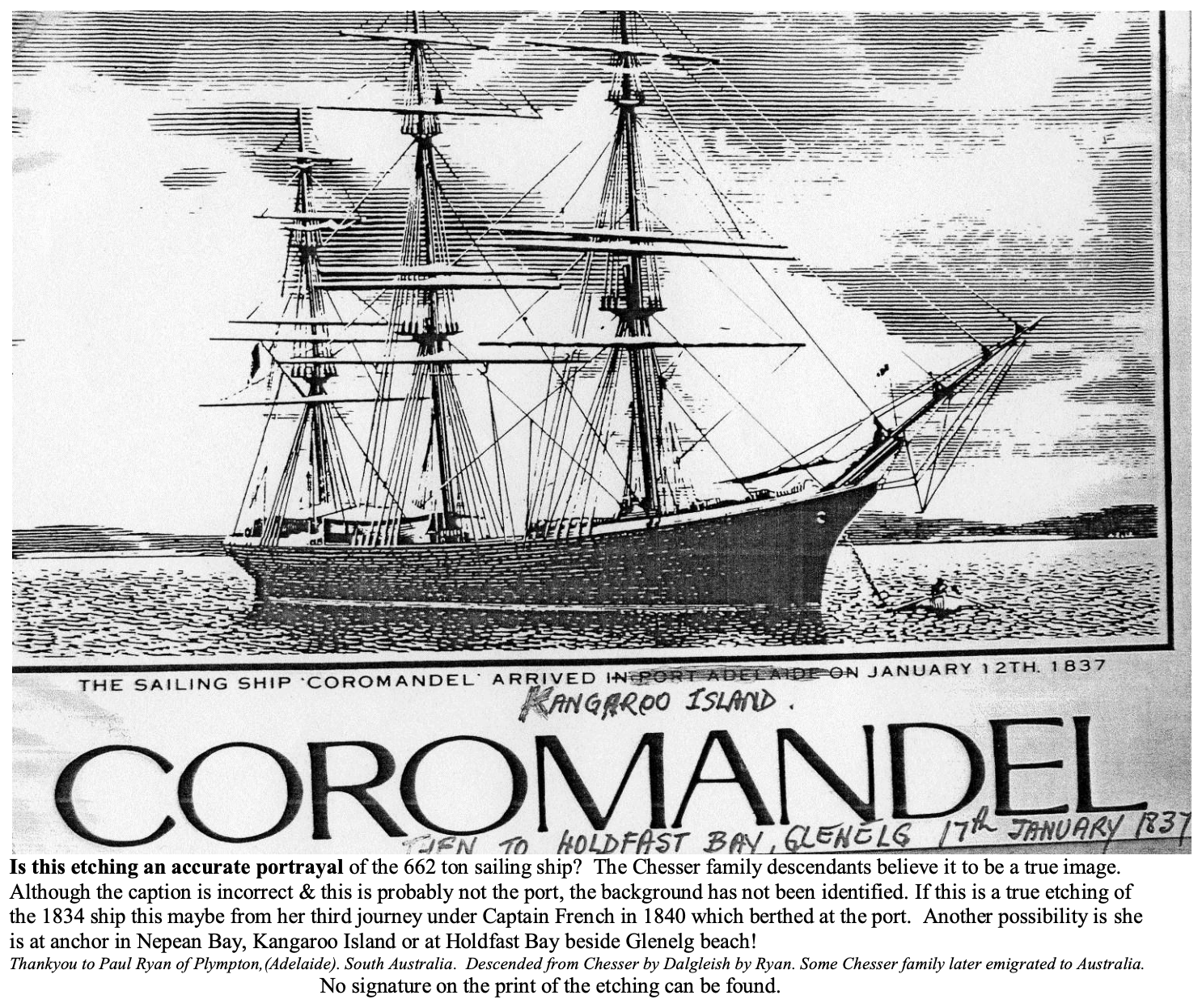
The Coromandel, the ship that Catherine antwo of her brothers, as well as her future husband sailed on to Australia in 1840. There seems to be no agreement on which voyage to the Antipodes this etching reprsents.
The place she arrived at barely yet existed as a colony in its own right: Port Phillip District was still administered as part of New South Wales, and would not become the separate colony of Victoria for another eleven years. Melbourne itself, founded only in 1835, was a raw settlement of a few thousand people.
Two of Catherine’s brothers, Patrick and James Parlon, made the crossing with her. And it was aboard the Coromandel that she met James Whitty, a fellow Irish immigrant en route to Australia.
In 1842, two years after their arrival—probably after Catherine and James had worked off their bounties—they wed in Melbourne. Over the following two decades they moved through a succession of small Victorian farming districts and outstations—Sheep Hills, Kilhatta, Woodstock, Darebin Creek, Coburg, and finally Moyhu, in the King Valley near Wangaratta. It was during these peripatetic years Catherine bore at least ten children, from James Francis in 1844 to Julia Marcella in 1862.
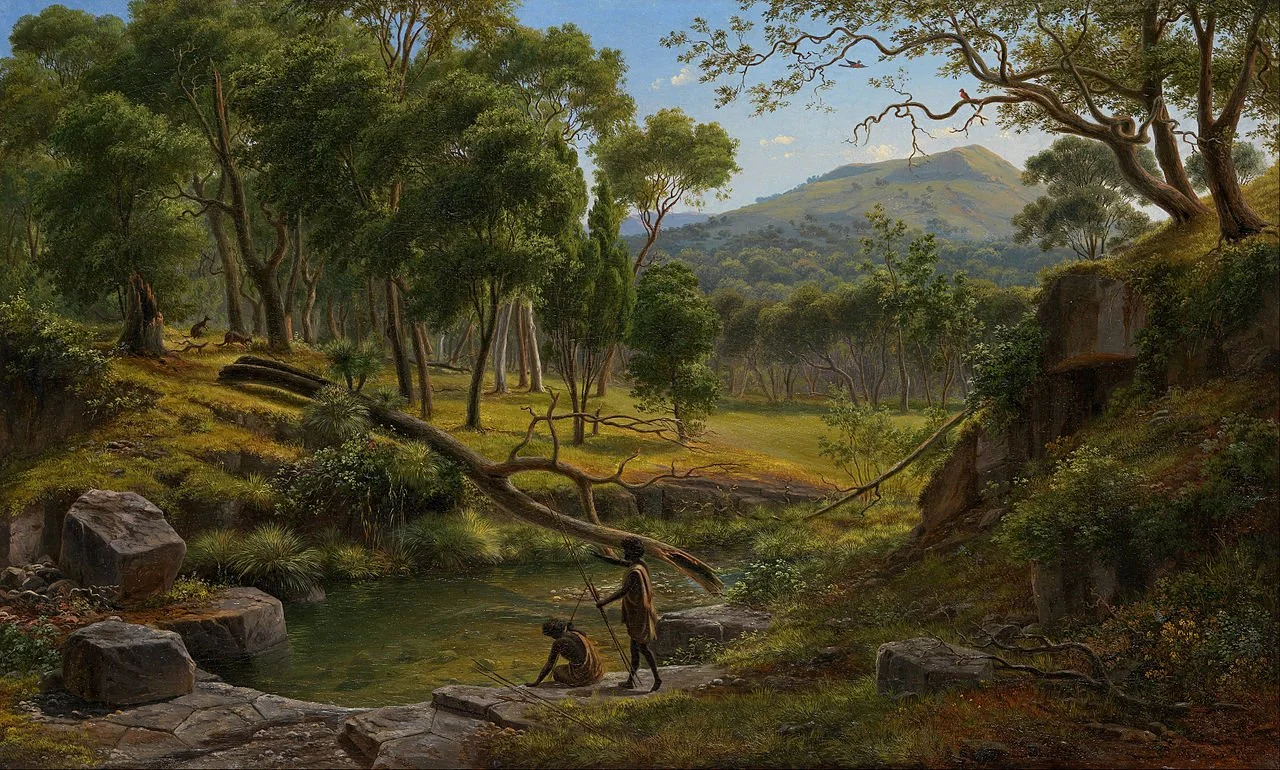
Warrenheip Hills near Ballarat, Eugene von Guérard, 1854
This restless pattern was typical of the colony's rapid pastoral and agricultural expansion in the 1840s and 1850s, as squatters and small settlers pushed steadily further from Melbourne into the Victorian bush, driving off or outright killing the Aboriginal people who had lived there for millennia.
Exactly what role did Catherine and James play in this horrific theft of life and land? Doubtless not a good one. They had fled colonized Ireland only to become the colonizers in Australia.
In their final stronghold, Catherine and James ran their livestock on 12,000 acres—18 square miles—around Boggy Creek near Moyhu in far northerneastern Victoria, a landhold that placed them squarely among the members of Australia’s growing squattocracy.

Remains of the Kelly house at Greta, near Catherine’s last home at Moyhu.
Their neighbors were the famous Kellys, a poor selector family trying to make a living on a parcel of land a fraction the size of Catherine and James’ station. The family was headed by a poor Irish convict, whose son, Ned Kelly, became the man of the family at age twelve when his father died.
Whether it was the impossibility of that role or not, Ned became an infamous outlaw and bushranger at a young age. His run-ins with James Whitty, whose horses he admitted stealing, were made famous in the Jerilderie letter, a manifesto he wrote while on the run in Victoria and New South Wales before he was captured and hanged at age twenty-five.
James Whitty, a squattor, famously hated Ned, a selector, and the feelings were returned in kind. But it was said that Catherine was kind to the Kellys and helped them out with food and supplies.
Catherine’s own life was marked by hard physical labor and huge risks, whether emigrating to Australia or birthing a multitude of babies on stations far from any help or trying to create a new life from literally nothing. She died relatively young, aged about fifty-seven, on 8 April 1874 at Moyhu.
James joined other local farmers to help fund the building of the Church of the Holy Cross at Moyhu. In Catherine's memory he commissioned the Melbourne firm of Ferguson & Urie—one of the colony's most respected stained-glass makers—to create the Rose Window for the altar, portraying the Madonna and Child. A brass plaque beside it recorded James’ devotion:
“The Rose Window of the mother and child above the altar in the sanctuary was presented by James Whitty of Boggy Creek in memory of his wife Catherine. Died 3rd April 1874, aged 52 years. R.I.P.”
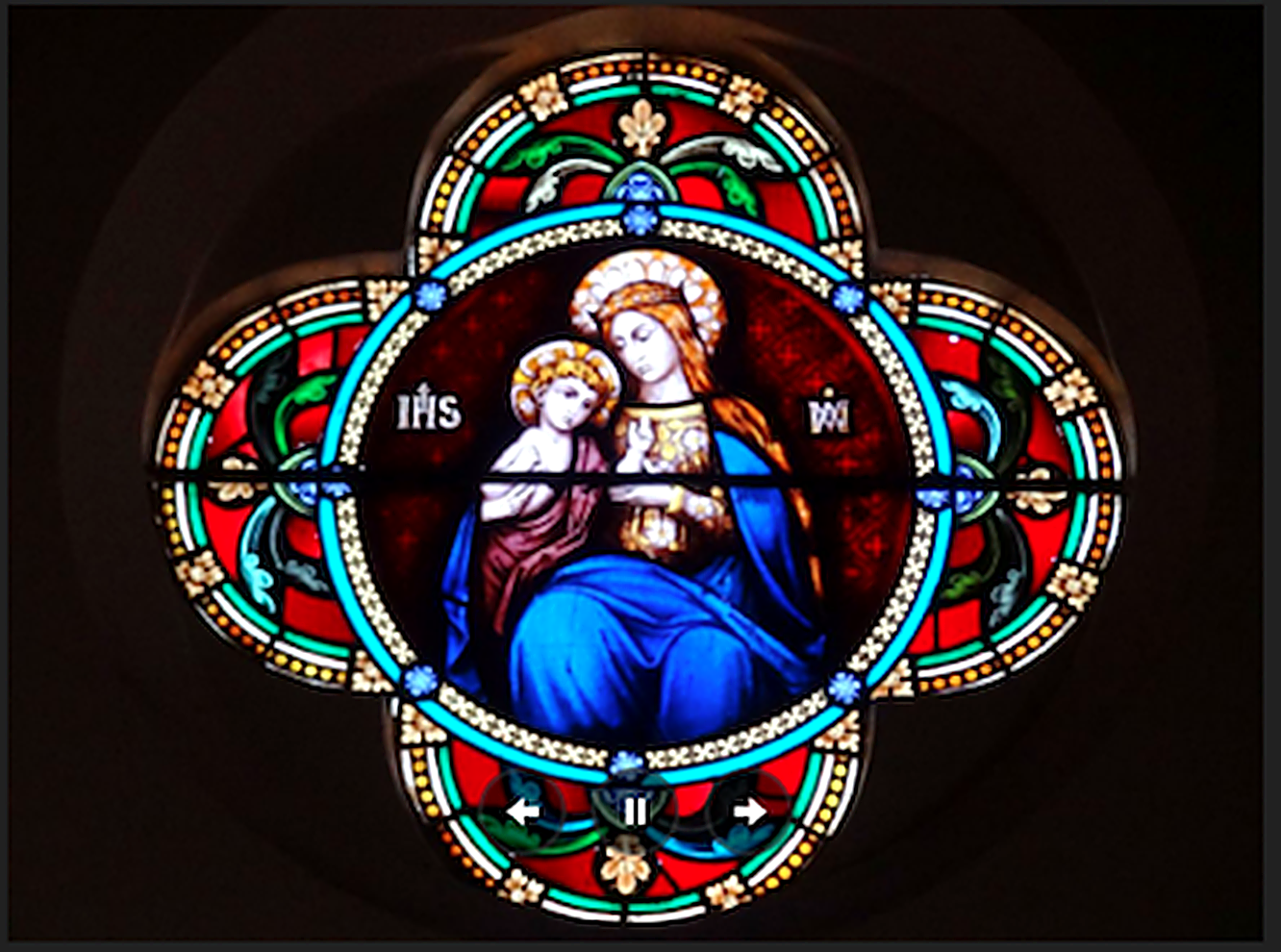
The Rose Window of Moyhu Church erected by James Whitty in memory of his wife Catherine Parlin Whitty.
And so Catherine, who arrived illiterate and indentured as a servant, was memorialized thirty-four years later in stained glass paid for by land she and her husband had wrangled into a cattle station. But that prosperity came at a heavy cost laid bare by the family's own records.
In the years after Catherine's death, tragedy visited the Whittys again and again: her daughter Mary died in 1877 age 30, her husband James in 1882 age 70, another daughter Ellen in 1884 age 24, her daughter Julia in 1886 age 24, her son John in 1887 age 35, and then, in a single terrible year in 1896, both her daughter Sarah Margaret age 38 and her eldest son James Francis age 52.
This run of deaths in early-to-middle adulthood reflected how precarious life was in nineteenth-century rural Victoria, where disease, childbirth, and accident carried off adults with regularity. Catherine Parlin's own life, with her near escape from famine to her family’s prosperity—hard-won from the unrelenting and brutally hard work of a pioneer woman—traces an arc of the long, difficult, often unrecorded passage of ordinary Irish emigrants into the fabric of colonial Australia.
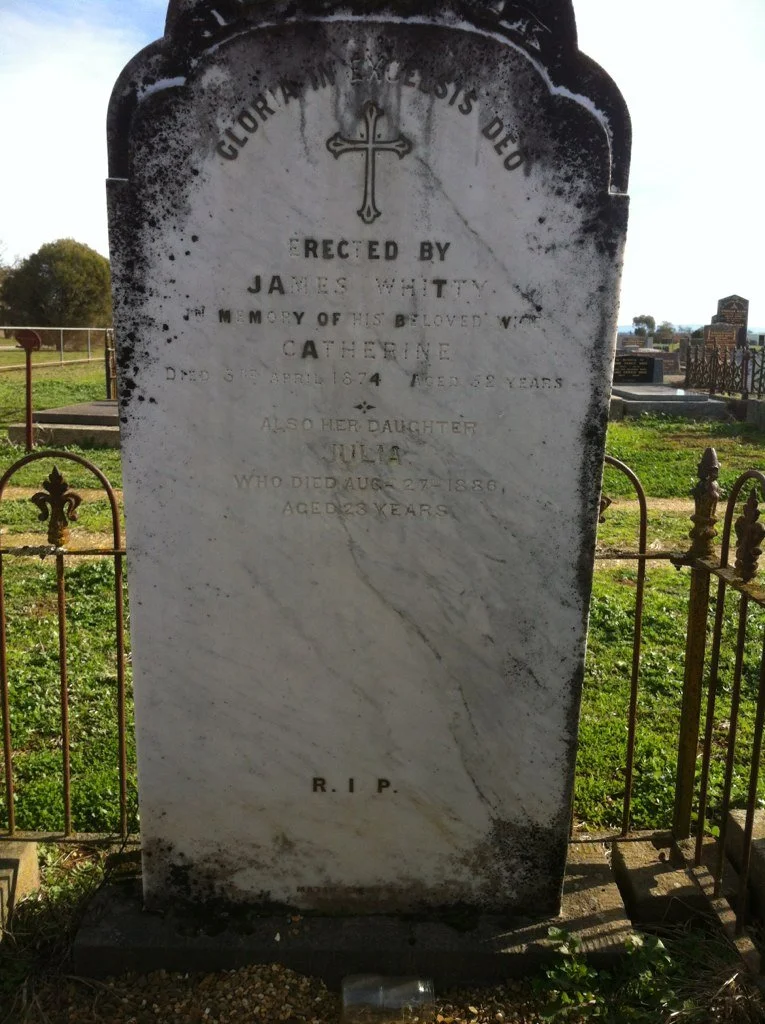
Catherine Parlin Whitty’s gravestone at the Milawa Cemetery, Victoria, Australia.