Edward Price (c.1785-1865) & John Edward Price (1814-1871): Two Lives Entwined at the Madras Mint
Third great grandfather and Second great grandfather to Patience Jewell Whitty
John Edward Price was born on 2 July 1814 in Black Town (Chennai), the commercial and residential quarter of Madras set apart from the fortified ‘White Town’ where the East India Company's British officials and merchants lived.
The geography of his birthplace told a story. Madras, like Calcutta and Bombay, had long organized itself along racial lines, with the Company's European elite clustered inside Fort St. George and the far larger population of Indian, Eurasian, Armenian, and Portuguese-descended residents living and working in the town beyond its walls.

Part of the Black Town, Madras, Thomas Daniell and William Daniell, 1797.
That John was born and baptised at St Mark's Church in Black Town placed him from birth within the colony's Eurasian and mixed community rather than its ruling European core.
His parentage placed him there just as firmly. On his baptism record his mother is named only as Maria, no surname, and described in the official document as ‘a deaf and dumb Native.’ His father went unnamed. But the infant’s surname gave the father away.
In actuality the father was Edward Price, an Englishman of real institutional standing who was, at the time of John's birth, already married to Harriet Temasfield, likely a Eurasian woman, possibly a European. Thus John was born illegitimately, the product of a relationship entirely outside his father's official life.
Was it a consensual relationship between Edward and Maria? Was she a member of his household staff? Did he take advantage of her status us a deaf and nonspeaking person? There is no way to know.
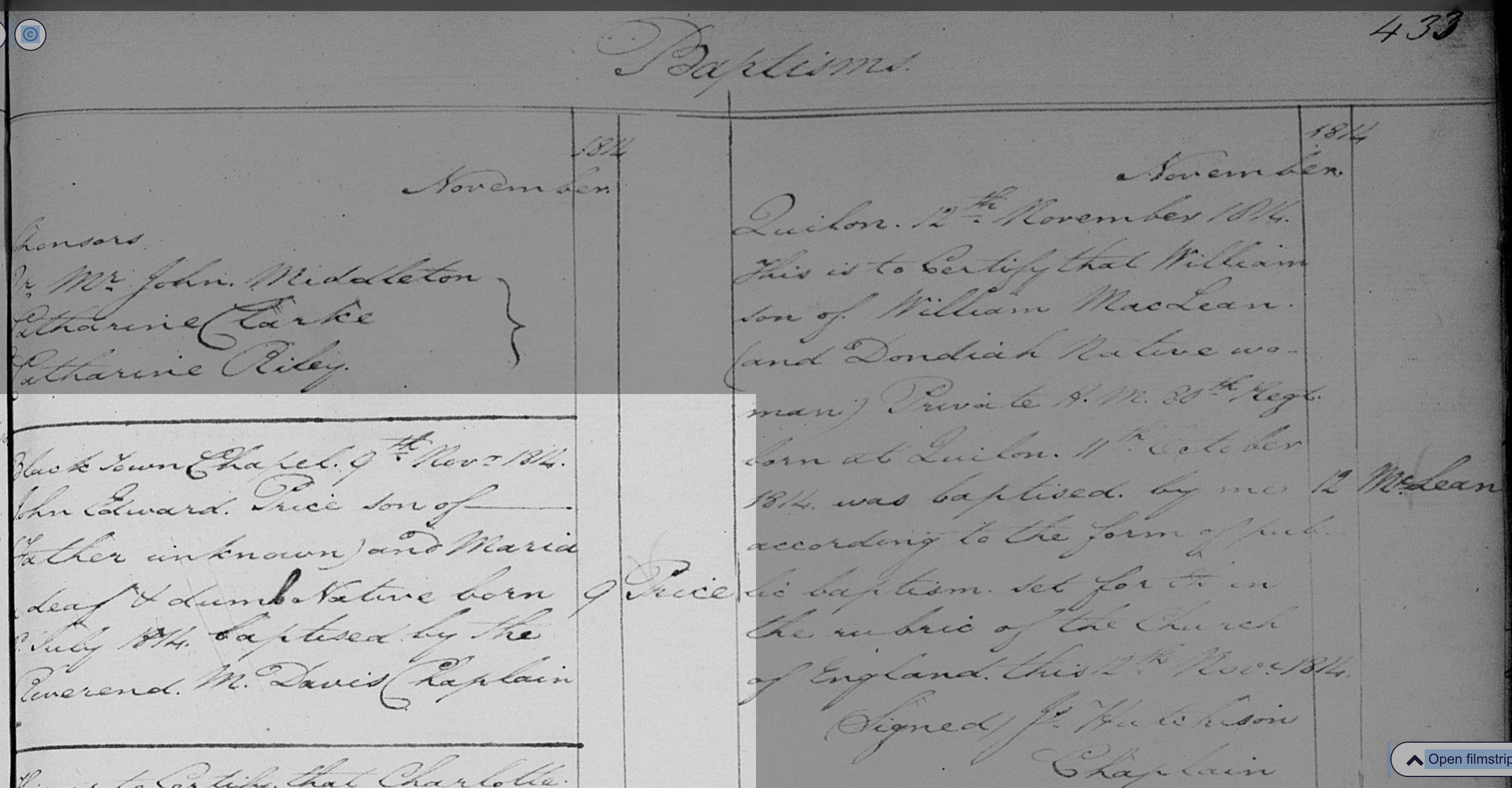
John Edward Price’s birth record (inside the light quadrant ), claiming ‘Father Unknown,’ and the mother named Maria, no surname, ‘a Deaf & Dumb Native.”
But this was a common enough pattern in early nineteenth-century Anglo-India, where informal and often unacknowledged unions between European men and Indian women were widespread, particularly before the arrival of larger numbers of British wives made such relationships less socially tolerated as the century wore on.
There are no further mentions of Maria in the records and what became of her is lost to history.
Edward Price, John’s father, came eventually to serve as the Assay Master of the Madras Mint and as a Mint Committee member during the critical transformation years of the early 19th century. His role was highly technical and administrative., and he was responsible for ensuring the chemical purity, intrinsic weight, and overall quality of all precious metals—gold and silver bullion—melted down into currency.
The Mint was also responsible for striking the iconic early currency of British India, including the Madras Pagoda, Mohurs, and fractions of the Rupee (like the Arcot Rupee).
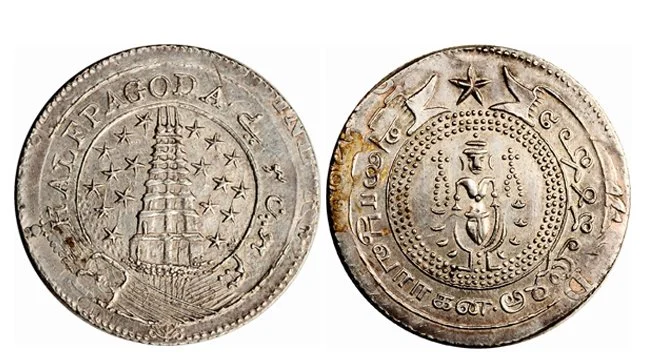
Left: British India Coins, Madras Presidency Half Pagoda 1808-1811 and on right: Madras Presidency 1-2 Pagoda 1808-1811.
Eventually Edward would ascend to the position of Head Accountant of the Madras Mint.
The East India Company strictly preferred hiring trusted English specialists like Edward Price to manage the Mint in order to prevent what they believed would lead to fraud or degradation of the currency.
It was during Edward’s tenure that the Madras Presidency completely overhauled its fractured monetary system, from what had been a complex dual system—a gold-based system (Pagodas and Fanams) and a silver-based Mughal system (Rupees).
Also during Edward’s time at the Mint, the new minting machinery housed inside White Town at Fort St George was moved outside the fort to the north of Black Town to avoid the extreme heat the machinery generated within the fort.
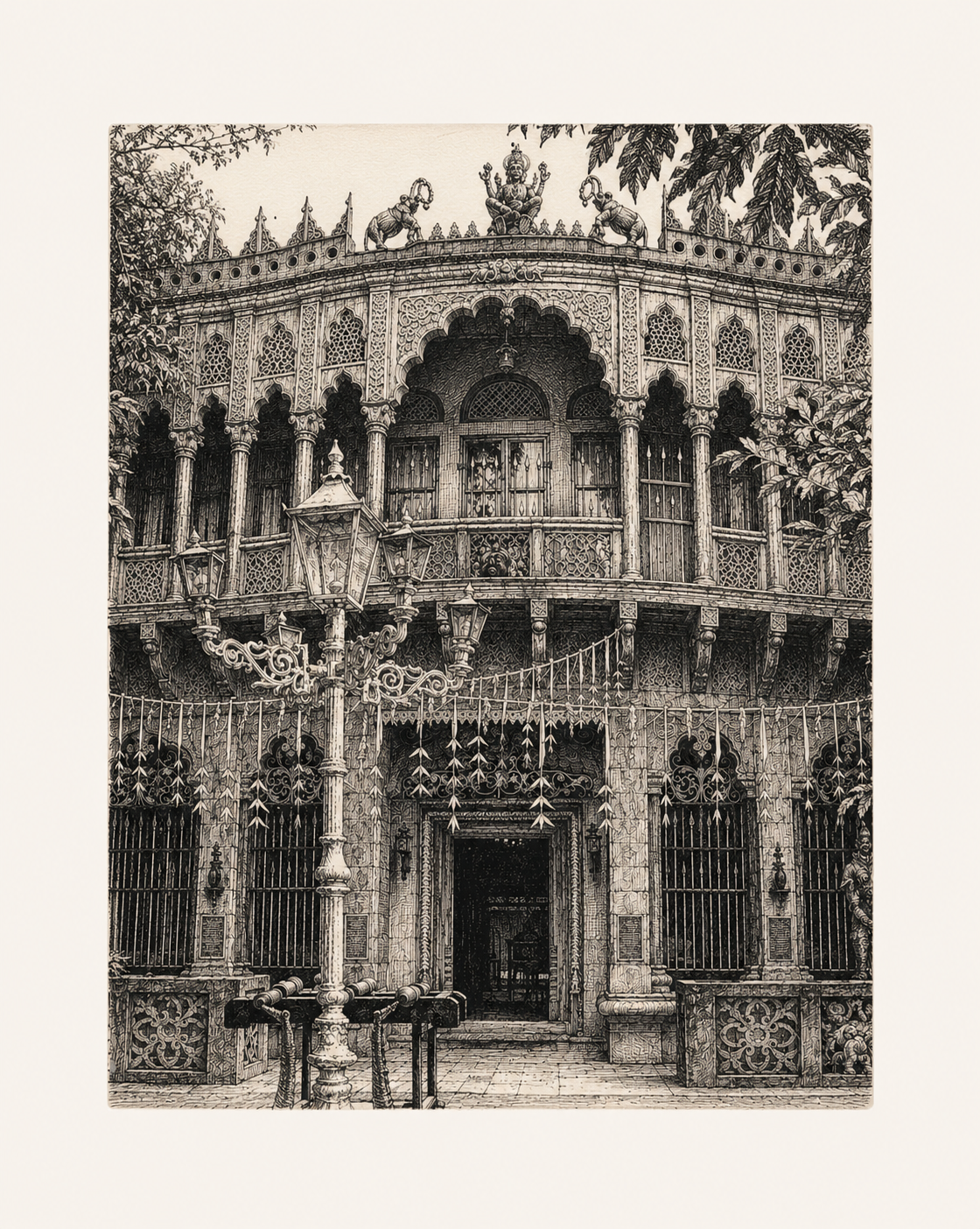
Old Madras Mint building.
At some unknown point Edward acknowledged his illegitimate Eurasian son and presumably helped him to a career in the Mint—for John followed his father into this same institutional world, eventually rising to Treasurer and Bullion-Keeper at the Mint.
By the end of his life he held the title of Treasurer and Bullion Keeper at the Paper Currency Office—a post that tracks one of the great financial transformations of British India. The Paper Currency Act of 1861 gave the colonial government, for the first time, a monopoly on issuing paper money across India, shifting the machinery of colonial finance away from mint-struck silver alone.
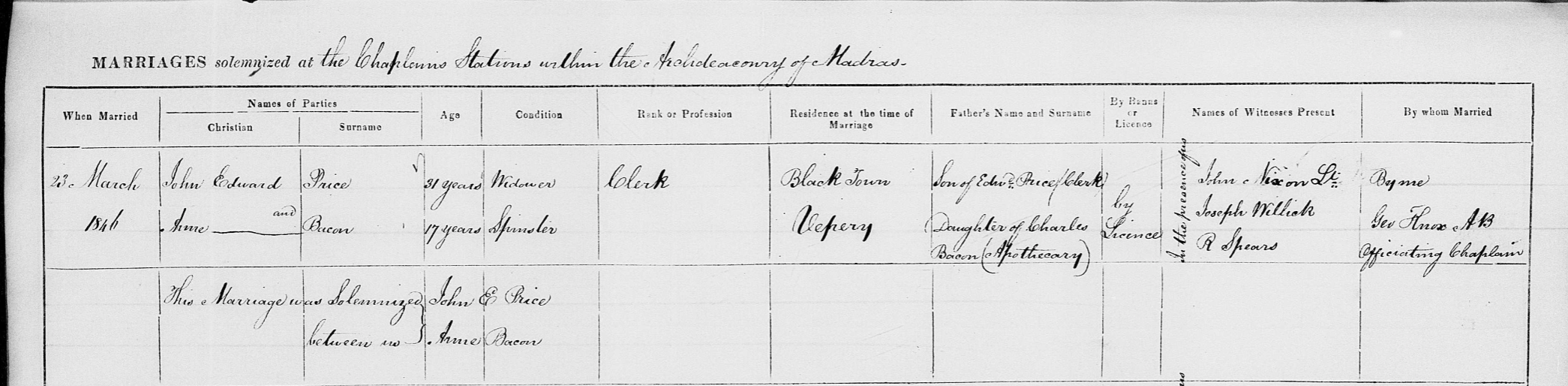
John Edward Price and Ann Bacon marriage record, Madras, 1846. John’s father is named as Edward Price, Clerk.
John's own family life doubled the scale of his father's. In 1837 he married Sarah Adelaide Rogé, herself from a Madras family of likely Indo-French descent, part of the same interwoven Eurasian Christian community. The couple had five children before Sarah died, aged 28, only two weeks after giving birth to a daughter named in her memory—one of the countless Anglo-Indian women lost to the era's high rates of childbirth mortality.
John remarried to Anne Bacon in 1846 and went on to have eleven more children with her, bringing his total offspring to sixteen—a sprawling brood that itself became one of the threads binding Madras's Eurasian community together, later marrying into families such as the Ollivers.
Edward Price may not have admitted his relationship to John at his birth, but by the time he died, he had apparently embraced the only son he was known to have fathered. Although Edward willed his entire estate to his only other child, a daughter named Harriet Pamella (Price) Cashart, in an act of rare intimacy, he ended up sharing a gravestone with his son at St. Mary's Cemetery, Madras—with nearly matching inscriptions:
“Edward Price Who Departed This Life on 17th August 1865 Aged 80 Years. Deeply Regretted by a Large Circle of Relatives and Friends.
”John Edward Price Death Date 13 August 1871, Age at Death 57 years 2 months and 9 days, Leaving behind him a large circle of relatives and friends to bemoan his irreparable loss.”
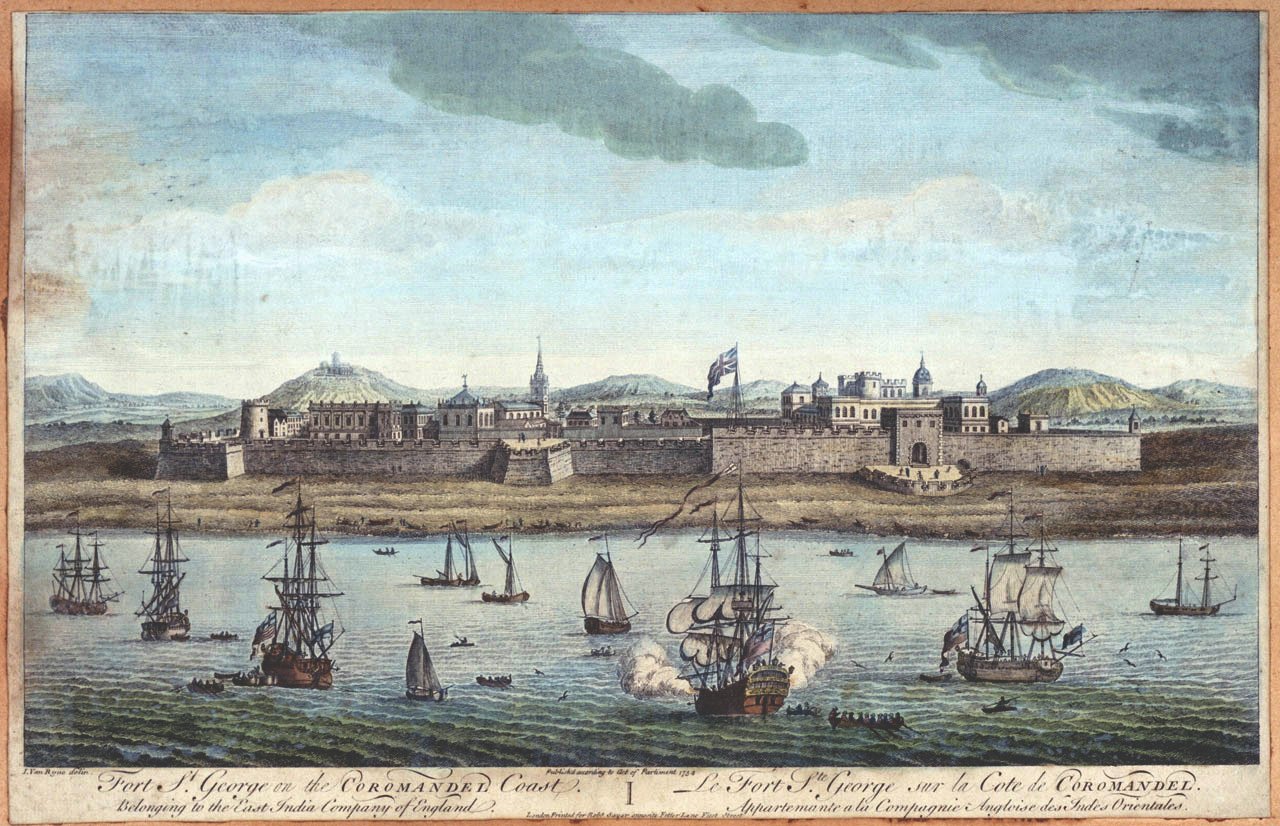
Fort St George, Jan Van Ryne (1712–60), 1745. At this time the fort still housed the Madras Mint, which would later be moved outside to Black Town due to the extreme heat generated by the Mint’s machinery inside the fort.
Between father and son, the family's institutional life traces the transition from a metal-based colonial economy to a modern, note-issuing one. This shift was driven by the transfer of authority in India from the East India Company to the Crown in the wake of the Indian Rebellion/Mutiny of 1857 in which the East India Company nearly lost their hold on India, and which marked the beginnings of the British Raj.
But that transformation was already ending the Mint's own long life. By the time John died in 1871, Madras' mint—after more than two centuries of operation—had been closed for two years, its work absorbed into the centralized mints at Calcutta and Bombay.
Thus Edward and John Price worked at an institution during precisely the decades of its final flourishing, their lives tracing almost the entire arc of Company-to-Crown administration in Madras.
As for the hard-won surname Price, it was carried on with devotion by Edward’s great granddaughter Alice Norma (Price) Olliver, who named almost all her children with it as a middle name. Together they carried it forth into the 20th century.

Flag of the British Raj: ‘Heaven’s Light Our Guide.’