William Stephens: Indefatigable In Chains (c.1784-1853)
Second great grandfather to Mark Stephens Whitty
William Stephens (sometimes spelled Stevens) was born around 1784, most likely in Waddon, a hamlet in Croydon, into the world of London's laboring poor at the height of the Georgian era.
He appears to be the William Stevens who by his mid-twenties was working at John Maud's chemical business on Aldersgate Street in the saltpeter room—a job that placed him at the center of one of London's essential industries. Saltpeter was the key ingredient in gunpowder, urgently needed by Britain, which had been at war with Napoleonic France for most of William's adult life.
It was from this very workroom, on 21 December 1809, that Billy, as he was known, and an older colleague, William Connor, were caught pocketing a few pounds of the mineral in their hats—an act of petty theft, by any measure, but one that fell squarely within England's notoriously severe ‘Bloody Code.’ Under those laws larceny of even modest value called for severe punishment.
_-_Prison_Hulk_in_Portsmouth_Harbour_-_BHC1923_-_Royal_Museums_Greenwich.jpg)
Prison hulks, Louis Garneray, 1810.
Tried at the Old Bailey on 10 January 1810, William was found guilty and sentenced to seven years transportation. He was twenty-six-year-old. What followed was the standard, brutal machinery of the era's penal system.
Since 1785 Australia had been deemed suitable for transporting Britain’s exploding population of convicts and more than one-third of all criminals convicted between 1788 and 1867 were sent there.
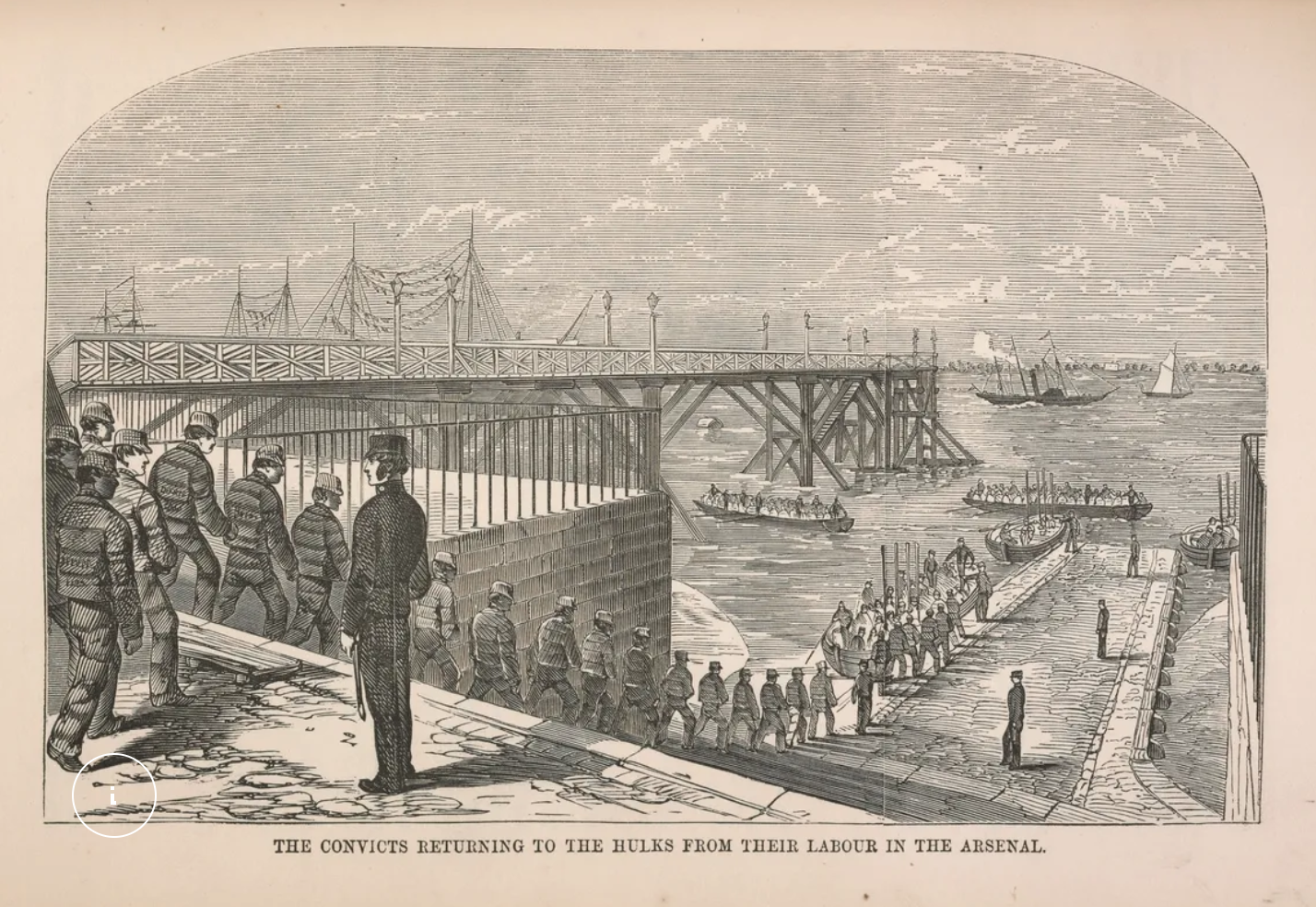
Convicts working along the Thames.
Before he was transported however, Billy spent two brutal years aboard the notorious prison hulk Retribution, moored at Woolwich on the Thames. It was one of the grimmest of Britain’s floating prisons, where roughly one in four inmates died of tuberculosis or ‘hulk fever’—typhus—while awaiting a ship to Australia.
Conditions aboard were abyssmal. No guard dared descend below decks at night, when 600 men in chains committed every manner of crimes against each other. The food aboard was barely edible and barely able to sustain life, particularly life for men working forced labor.
During the daylight hours, when the men were not aboard the hulk, they worked up to sixteen hours a day dredging the Thames and building the docks that expanded London's own imperial trade.
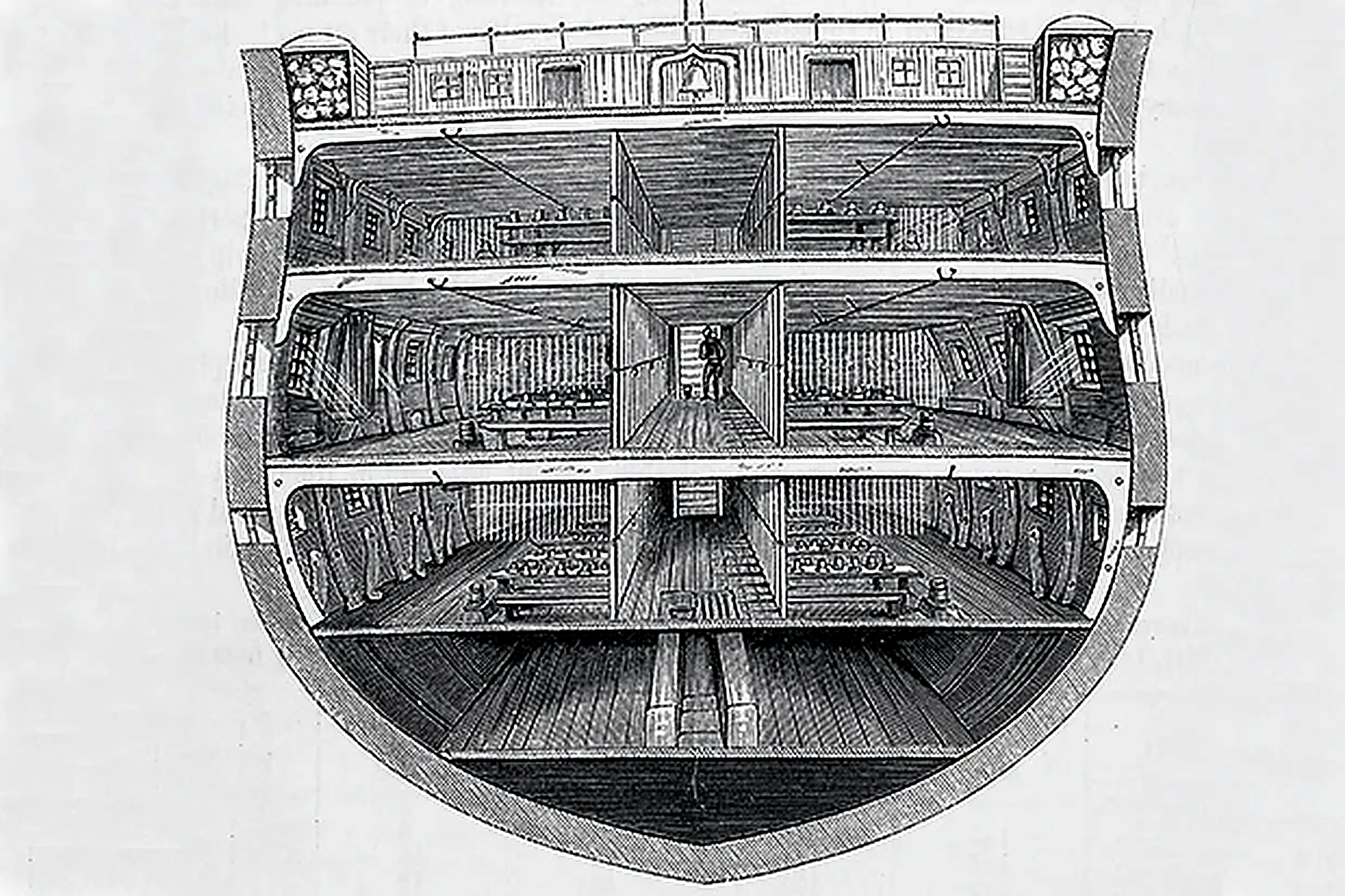
Inside a prison hulk, minus the 600 prisoners in chains.
In April 1812 Billy was at last transferred to the convict ship Indefatigable, one of the earliest vessels to carry convicts directly from Britain to the fledgling settlement at Van Diemen's Land.
The colony was barely eight years old at the time, still little more than a cluster of huts clinging to the edge of an unmapped island. The brutal voyage took 137 days, or four-and-a-half interminable months spent in the hold in chains.

A three-masted square-rigged convict ship similar to Indefatigable that William sailed aboard to Australia.
Somehow William survived this too, and eventually he was offloaded—probably at Indefatigable’s second stop at Port Jackson (Sydney, New South Wales). Over the coming years his life in the colonies traced a pattern familiar to many transported convicts: neither total ruin nor clean redemption, but a long, uneven cycle of minor trouble, hard-won respectability, and renewed hardship. He appears to have absconded from assigned employment as early as 1814.
Then in 1820 he was carried aboard the Deveron to Van Diemen’s Land. This was a ship that regularly shuttled prisoners between the two penal colonies, with Van Diemen’s Land typically the destination for prisoners who had re-offended elsewhere in Australia—although the facts of Billy’s transfer to Van Diemen’s Land are not clear. Instead, by 1820, he might have been pardoned of his original sentence. If so, then he appears to have come to Van Diemen’s Land as a free man.
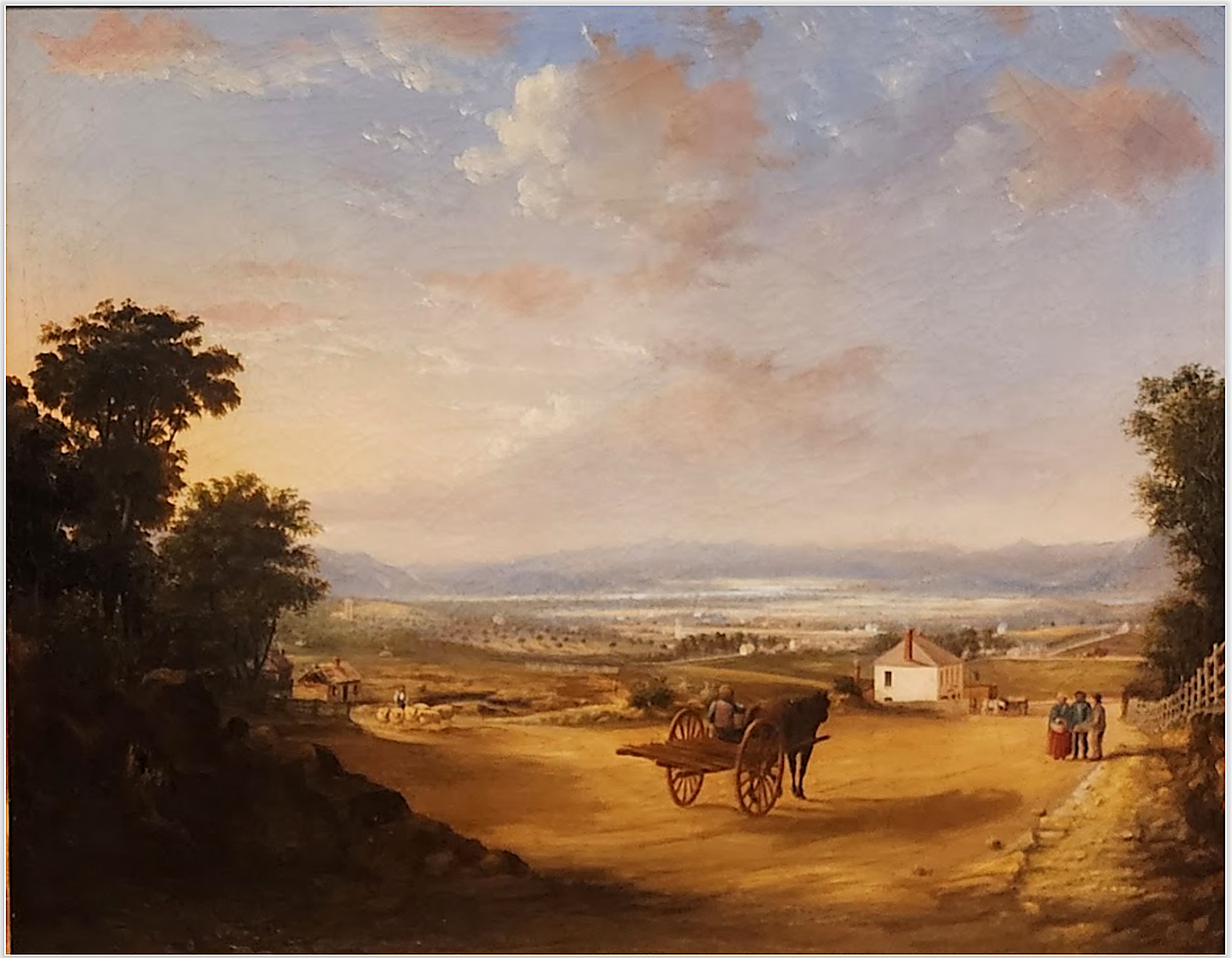
Carter Along the New Town Road, Van Diemen’s Land.
Nine years later, in 1829, in Hobart Town, he married Elizabeth Adshead Frankland—herself a transported convict, condemned at the Old Bailey and reprieved from a death sentence. She had arrived in Van Diemen’s Land in 1827 aboard the convict ship Sovereign. Their first child was born just three months after the wedding.
By the mid-1830s the couple had built a modest respectability, with William working as a carter, hauling goods by horse and cart around Hobart Town and beyond.
At this time William advertised a ‘genteel cottage residence’ to let on New Town Road. He also owned a house with three cottages on Macquarie Street in Hobart Town—real property, a tangible marker of how far transportation's supposed disgrace could be overcome by hard work.
But that stability proved fragile. In 1839, while working as a carter—a trade built entirely on the trust of merchants who needed their goods hauled reliably through the streets of Hobart Town—Billy was arrested for stealing two wooden staves. He claimed to be helping out a homeless man who said the staves were his.
Despite many local merchants speaking up on William’s behalf, he was tried for the theft, convicted, and sentenced to twelve months' hard labor, on bread and water only, on a chain-gang road gang at Bridgewater on the River Derwent. He was fifty-five years old.
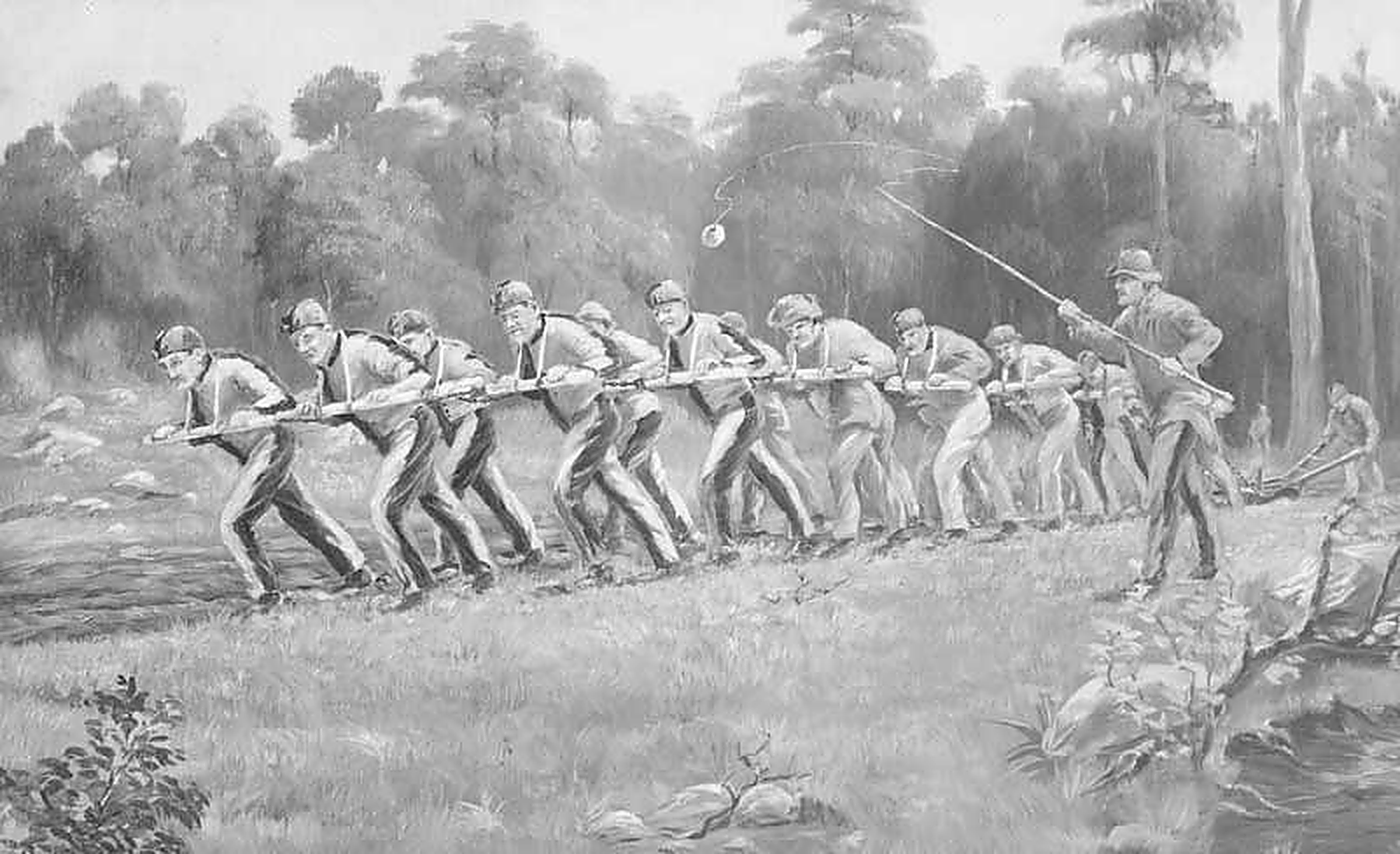
Convict road gang, Van Diemen’s Land. Note the overseer with some kind of weighted whip.
Newspaper accounts from the time are strikingly sympathetic. One describes William as bearing ‘a very high character in his calling as a carter,’ and noting that merchants trusted him with goods worth thousands of pounds.
These accounts were suggestive of a man whose reputation had genuinely outpaced his convict origins, even as the same colonial legal system that had once transported him remained ready to send him back into chains over a dispute worth a few shillings.
During Billy’s imprisonment, he and Elizabeth lost their Macquarie Street property and Elizabeth supported herself and their five children by returning to her former trade as a seamstress, and perhaps also by teaching. She appears to have moved the family into their New Town property.
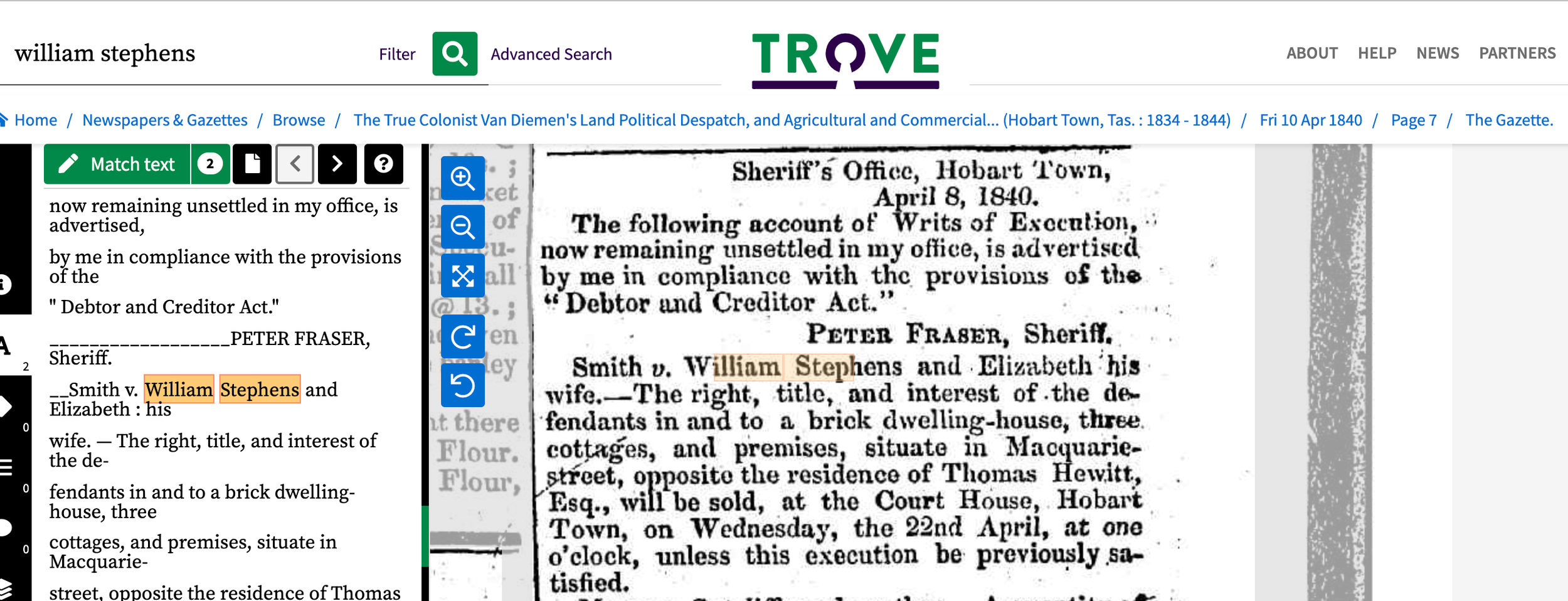
William was pardoned for the theft in 1840. Yet he brushed up against the law once more in 1841 over a missing firkin of butter he was carting. But this time he was quickly cleared of the charge.
By 1845 he was declared insolvent, perhaps too old by then and too broken by the chain gang to be able to work anymore—indefatigable no more.
William Stephens died on 20 May 1853 at his home on New Town Road, after a three-month battle with influenza. He was sixty-nine years old. By then he had dwelt in Van Diemen's Land for over forty years—nearly the entirety of the colony’s history—from its first decade as a raw penal outpost through its transformation into a settled society still being built on the brutally forced labor of men and women in chains.