Elizabeth Adshead Stephens: From the Gallows to Van Diemen's Land (1793–1861)
Second great grandmother to Mark Stephens Whitty
Elizabeth Adshead was born on 13 April 1793 in Whitechapel, Middlesex, a parish of tanners, weavers, and the working poor pressed up against the eastern wall of the City of London. Her birth was registered not in a Church of England register but at Dr Williams Library in Cripplegate, the great nonconformist registry established for Dissenters who refused Anglican baptism.
She was the daughter of Timothy Adshead and Elizabeth Robinson. The family's Dissenting faith would prove one of the few constant threads in a life that would unravel and remake itself entirely on the other side of the world.
Elizabeth grew up to be a dressmaker, which placed her among the most exploited workers in London—women who sat in airless rooms stitching by candlelight for twelve to sixteen hours a day, paid in pennies, with no recourse if a client refused to pay or an employer dismissed them without notice.
On Christmas Day 1817, at age twenty-four, she married Benjamin Frankland, a hatter, at St Botolph Bishopsgate. They had at least one son, also named Benjamin Frankland. Four years into the marriage, In 1821, her husband sailed aboard the Thames to New York City—ostensibly to arrange for his family to follow. He was never heard from again and likely died soon after arrival.
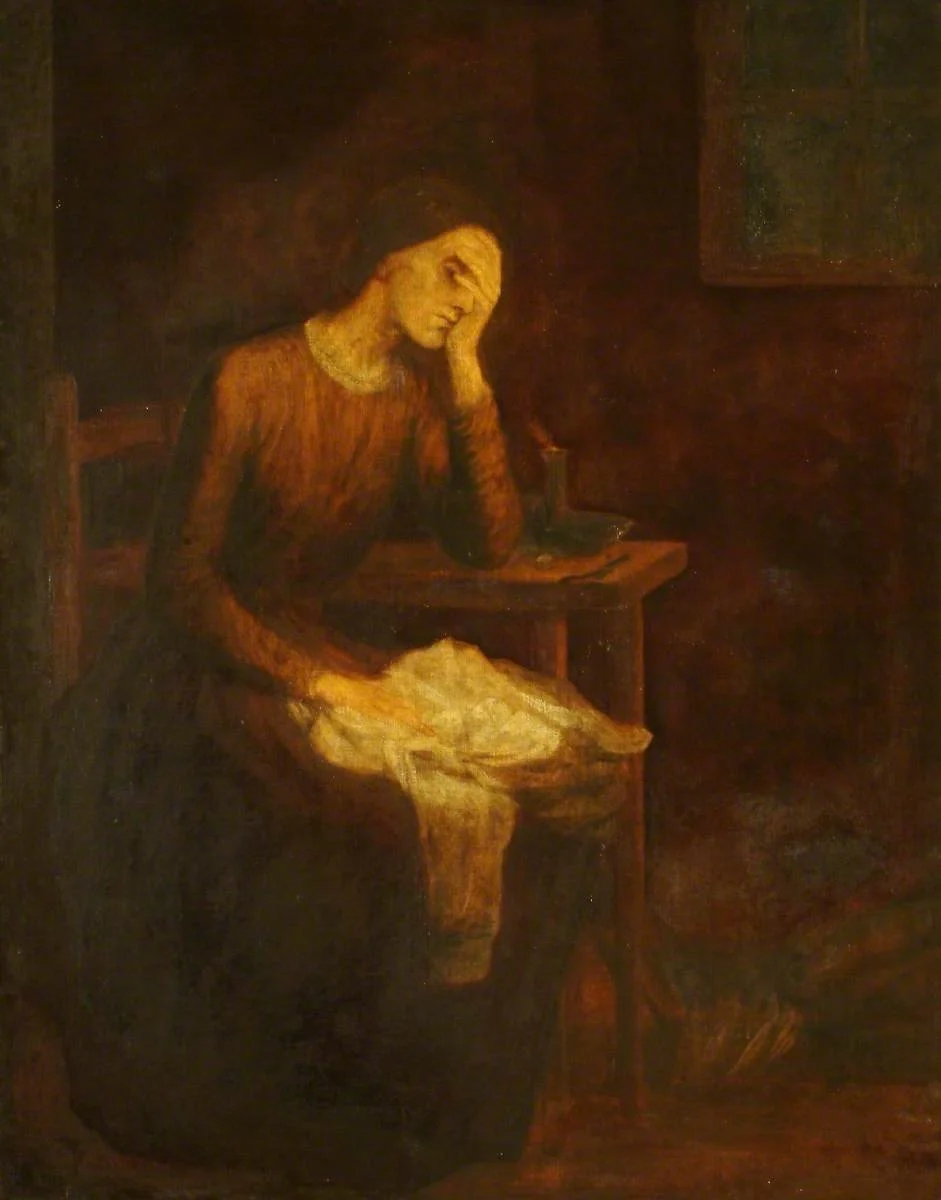
Song Of the Shirt, George Frederic Watts, circa 1850.
For six years Elizabeth raised Benjamin alone, surviving by her needle. Then, in the early hours of Sunday 4 March 1827, she made a decision that would define the rest of her life.
She was lodging at the home of Richard and Lucy Alloway in Ball's Pond Road, Islington. She knew where Lucy Alloway kept her savings—twelve sovereigns and several pounds in silver—in a pocket under her pillow. While the Alloways slept, Elizabeth opened the kitchen window, took the pocket, removed eight pounds in coin, and attempted to establish the fiction of a burglary by scattering some of the linen in the yard. Her son Benjamin, now nine years old, was asleep somewhere in the house at the time.
The story she told when the Alloways awoke—of two masked men with a dark lantern, a ransacked room, and a stolen pocket—was not believed. A week later, when the officer James Hanley came for her at her sister's house in New Kent Road, she confessed almost immediately, saying:
““I was very sorry for what I had done.””
She then directed the officer to where she had left the counterpane and the flannels and declared that she had taken eight pounds of coin as well. Elizabeth was tried at the Old Bailey on 5 April 1827, before Lord Chief Justice Abbott. Upon being called on for her defense she burst into tears and spoke her first and only words during the trial :
“I leave it entirely to the mercy of the Court!”
The jury immediately found her guilty, and the judge handed down the harshest sentence possible: Death.
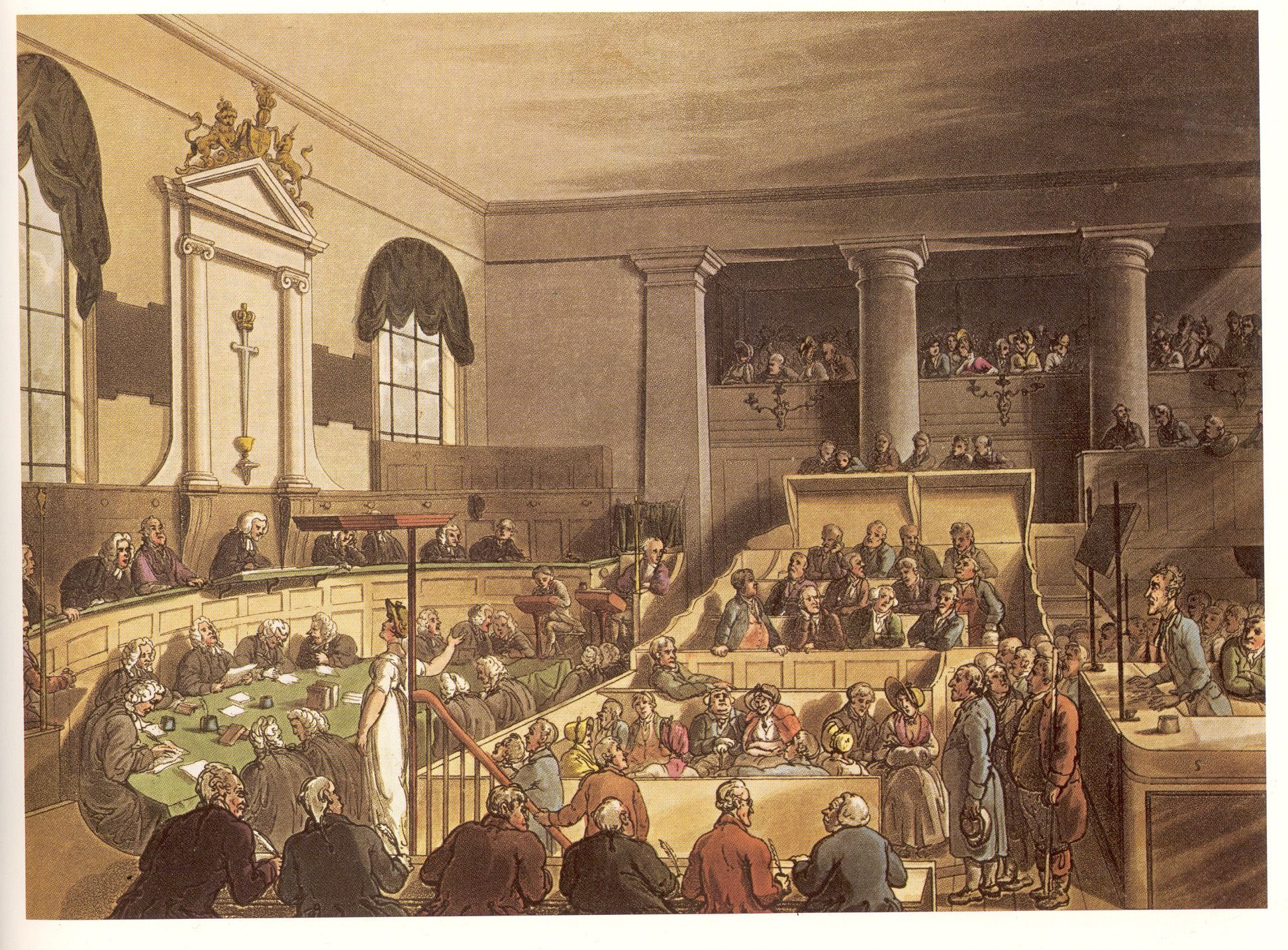
Augustus Pugin and Thomas Rowlandson, Old Bailey Courtroom (1809).
The Old Bailey in the 1820s handed down death sentences the way a later era would hand down community service orders, with the assumption that most death sentences would be commuted. Yet the commutation was not automatic and the weeks between sentencing and reprieve were spent in the condemneds’ hellish cells.
A petition of eight signatures, including that of her son Benjamin, was submitted to the court on 23 May 1827. Thereafter her sentence was commuted to ‘Transportation for Life, Beyond the Seas.’ She would never be able to return to England.
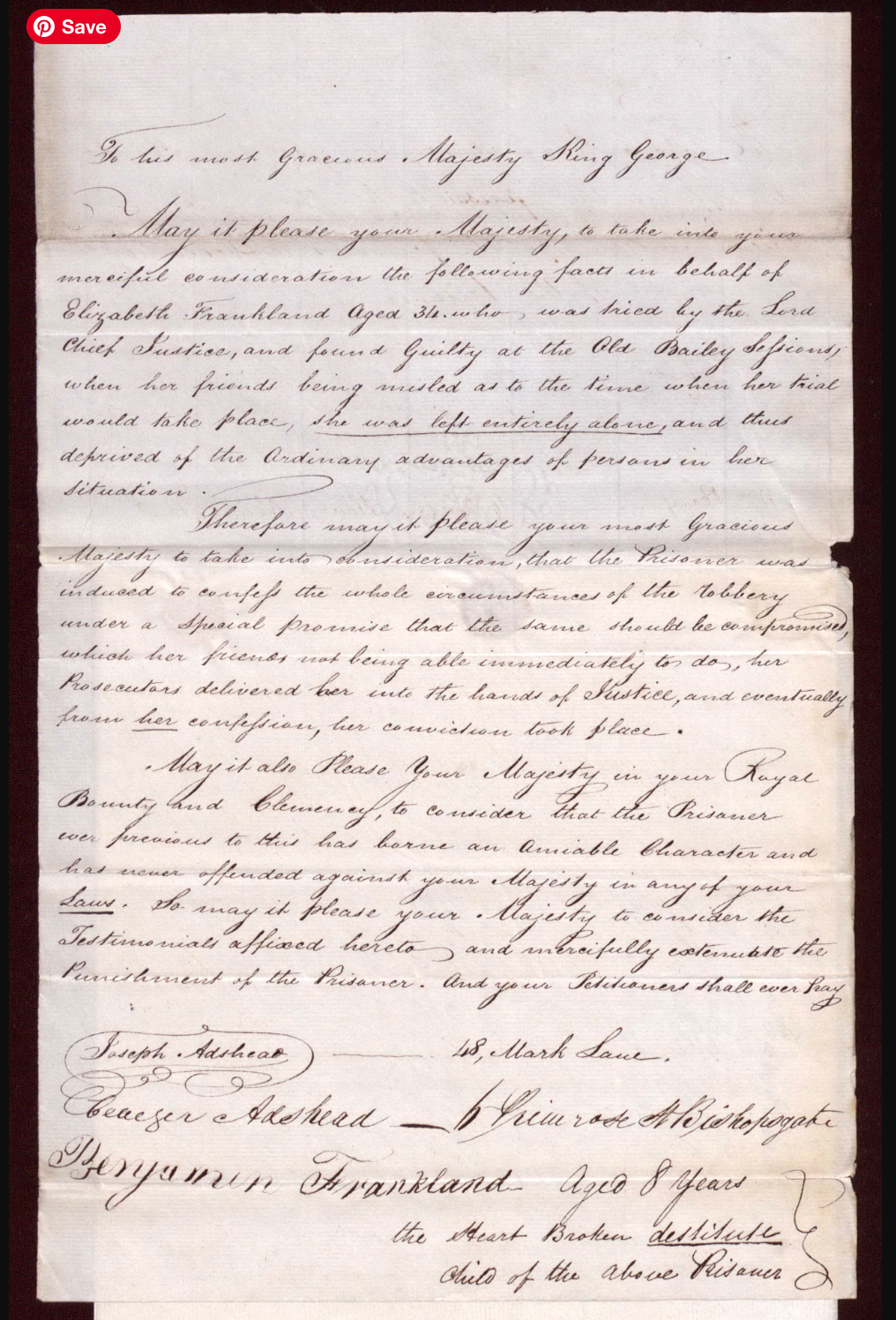
A letter pleading leniency for Elizabeth Adshead Frankland, signed by several family members including her eight-year-old son, Benjamin Frankland, describing himself as “the heart broken destitute child of the above Prisoner.”
Elizabeth departed England forever on 12 July 1827 aboard the Sovereign, carrying eighty-one female convicts and twelve children, including Elizabeth’s son, Benjamin, now aged nine.
The ship's surgeon Robert Malcolm noted in his journal that the women embarked in a state of profound distress, cut off from everything they knew, uncertain of everything ahead.
He recorded no complaints about Elizabeth during the voyage and described her conduct as exemplary.
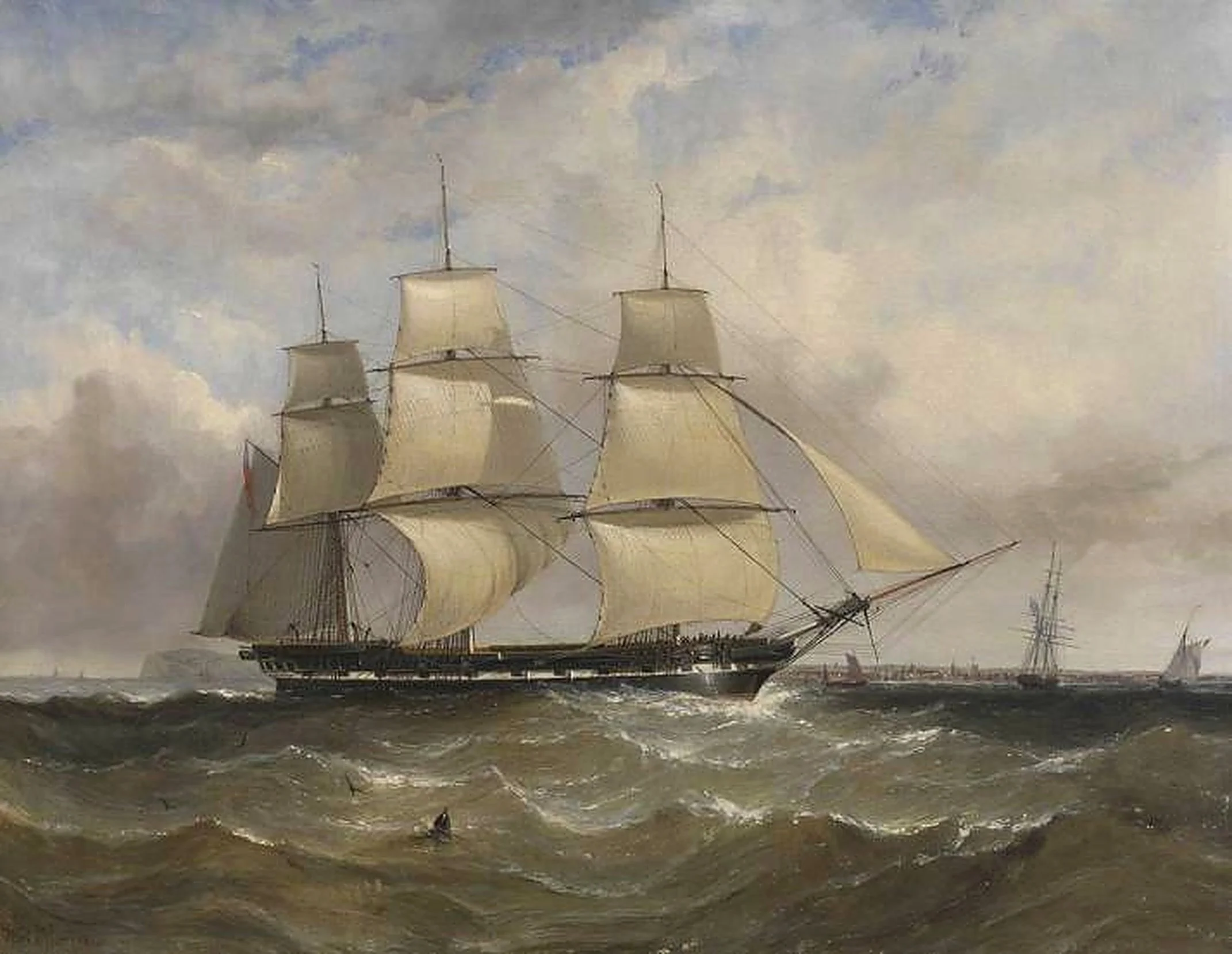
Convict ship to Van Diemen’s Land.
The Sovereign arrived in Hobart Town, Van Diemen's Land (now, Tasmania, Australia) on 19 November 1827 after 131 days—nearly four-and-a-half months—at sea. It was the first cargo of female convicts to sail directly to the colony.
The women prisoners were sent partly to redress the severe gender imbalance of Van Diemen's Land, where females were few, free or convict.
Likely because of her skills as a dressmaker, Elizabeth was assigned on landing to John Burnett, the Colonial Secretary. His career would later be described in the Australian Dictionary of Biography as rife with self-interest and incompetence. At that time dressmakers were a rarity in Van Diemen’s Land and the Colonial Secretary’s wife would have not doubt desired Lucy’s skills.
But whatever her work with the needle, in February 1828, and only two months into her assignment, Elizabeth was reported for ‘indecent and immoral conduct with a fellow convict named Paul Pierce,’ who was also in service to Burnett's household. While Pierce was only reprimanded, Elizabeth was confined in a cell on bread and water for seven days.
Thereafter she was designated ‘assignable only in the country’—meaning she could no longer be placed in a household in Hobart Town. Her nine-year-old son was removed to the Queen's Orphanage, a place of brutality and death in nearby New Town. The separation was the harshest consequence of an offense that, as a descendant later wrote, might have been as much a symptom of Burnett's—or perhaps his wife’s—hostility to having mother and child in his house than any genuine moral transgression.
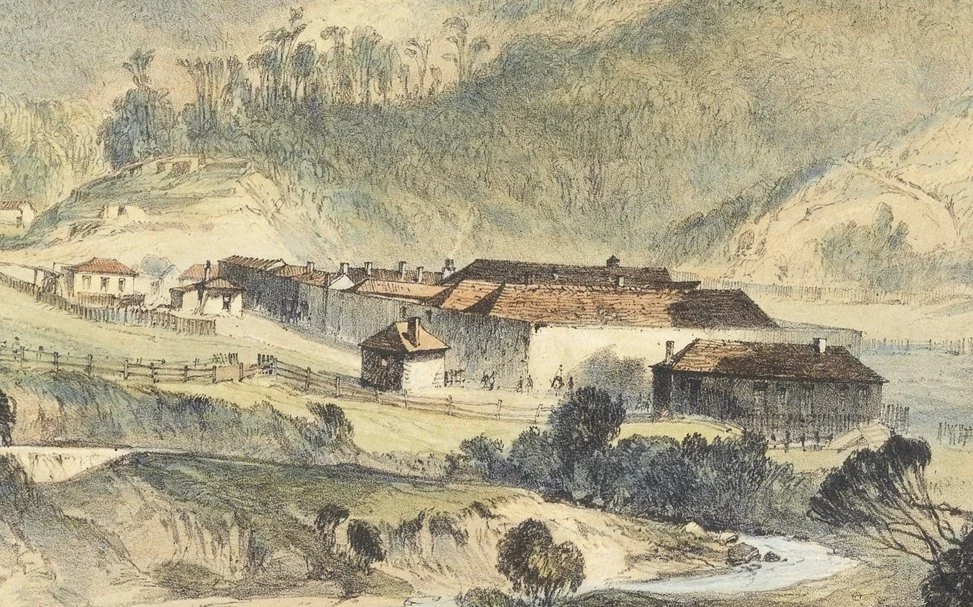
Cascades Female Factory, Hobart Town, Van Diemen’s Land. More than once, after several colonial transgressions, Elizabeth was confined here in cells, in solitary confinement, in complete darkness, on bread and water only.
Somewhere out ‘in the country’ Elizabeth met Williams Stephens, the man she would marry in Hobart Town the following year, on 10 July 1829. William was himself a pardoned convict, transported seven years earlier for stealing saltpetre from his employer in London. He too had been tried at the Old Bailey, in his case in January 1810.
Together in Van Diemen’s Land Elizabeth and William built a family: Jemima Stewart, born October 1829 just three months after the wedding; Elizabeth Harriett; William Timothy; and Joseph Adshead, the son who would one day be beside his mother when she died.
No question that life in Van Diemen’s Land provided a better existence for Elizabeth and her family than life in Dickensian London. But survival as a convict in a brutally punitive colony was never easy. In 1839 her husband William was arrested, then tried and convicted of stealing two planks of wood.
He was sent north to Bridgewater, sentenced to a year of hard labour on a chain-gang road crew. He was fifty-five years old. The family lost their house and cottages on Macquarie Street, in Hobart Town and it’s unclear how Elizabeth and the children survived this separation, most likely by Elizabeth returning to sewing.

“The Seamstress,” by Caspar Netscher.
Records show Elizabeth teaching needlework in New Town, the suburb north of Hobart, where she and William had settled. A volume of Tasmanian Ancestry records her in operation there:
"Children were encouraged to bring their own articles of work from home. This was the case at a New Town School conducted by Mrs Elizabeth Stephens."
It was the same skill that had sustained her in London, the same needle and thread, the same patient hands. Her talents had sustained her in poverty, carried her around the world in the hold of a convict ship, set her to work in the mansion of the Colonial Secretary, and finally sustained her by teaching in a colonial schoolroom on the far side of the Earth.
In 1841 Elizabeth finally received her Free Pardon, fourteen years after arriving in the colony, and twenty years after her first husband abandoned her in London. She was forty-eight years old.
A widow for eight years at the end of her life, Elizabeth died on 16 May 1861 at New Town, at the house of her son Joseph Adshead Stephens. The cause of death recorded on her certificate was ‘Debility and Old Age.’ She was sixty-eight years old, having survived thirty-four years beyond her brush with the gallows.