Elizabeth Petworth Cooper: A Life In Hiding Beyond the Seas (c.1834–1897)
Great grandmother to Mark Stephens Whitty
Elizabeth Petworth was born around 1834 in the small Hampshire village of Bramshott, the daughter of Sophia Lemmon and, possibly, James Petworth. She was baptised in December 1837, nearly two years after James Petworth’s death, in a record that named only her mother, no father. Another baptismal entry listed Sophia as a widow.
This pointed to a father who had died or vanished or perhaps been imprisoned before Elizabeth's birth, a common enough predicament in rural England during the hungry years of the 1830s, when the New Poor Law of 1834 had just reorganized relief for the poor around the harsh discipline of the workhouse. James did in fact spend twelve months in prison in 1824 for receiving stolen goods.
Later, when Elizabeth emigrated to Australia, she gave her father's name as James Petworth. So perhaps she was conceived before he died.
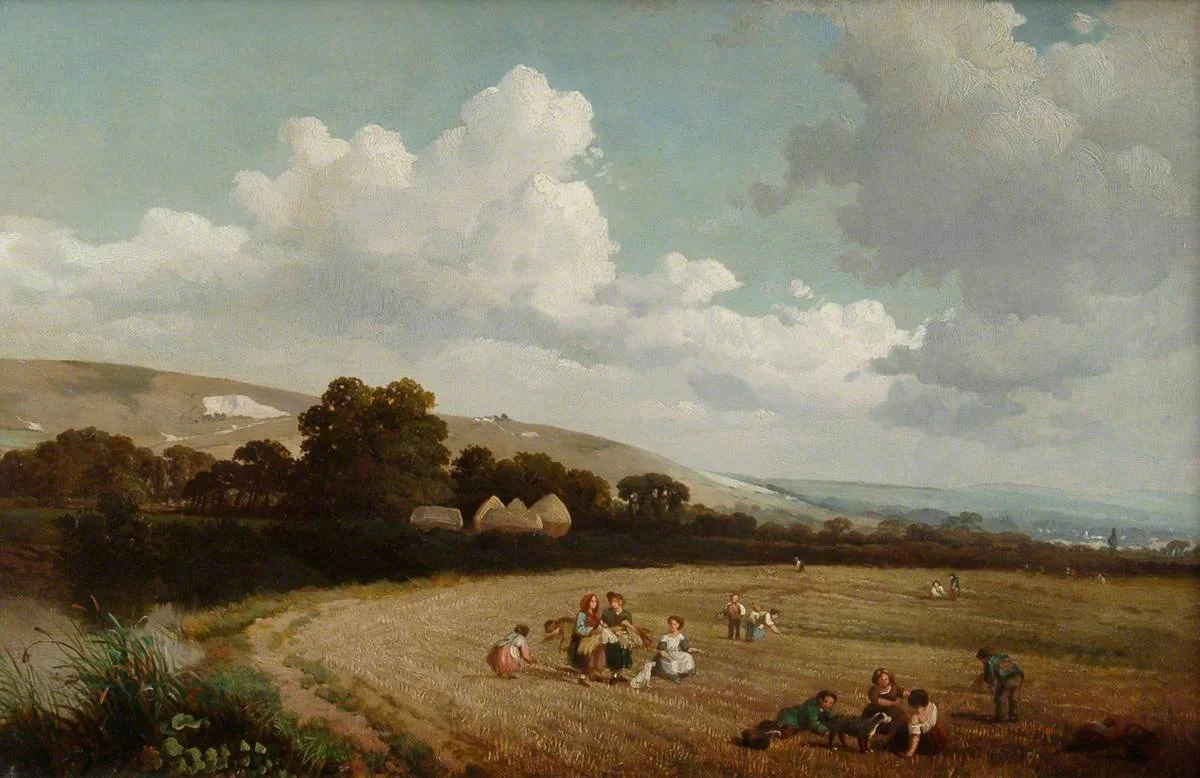
Hampshire, England landscape. Alfred Collins.
Hampshire in these decades was a county of agricultural depression. Wages for farm laborers had stagnated for a generation, mechanization was displacing rural workers, and the Swing Riots of 1830—protests against threshing machines and dwindling pay that manifested as the largest movement of social unrest in 19th century England—had rippled through the country only a few years before Elizabeth's birth.
For a family like the Petworths, with limited prospects at home, the great wave of assisted emigration schemes that Britain organized through the 1840s and 1850s offered one of the only paths out of poverty.
Elizabeth took that path in 1854, sailing as an assisted immigrant to Australia aboard the Anglo Saxon. On the ship’s manifest her occupation was listed as general servant.
She arrived in New South Wales at a pivotal moment. The eastern colonies, especially New South Wales, were in the grip of the gold rush that had begun in 1851, drawing in male labor so thoroughly that colonial governments subsidized the passage of young single women as a matter of demographic policy.
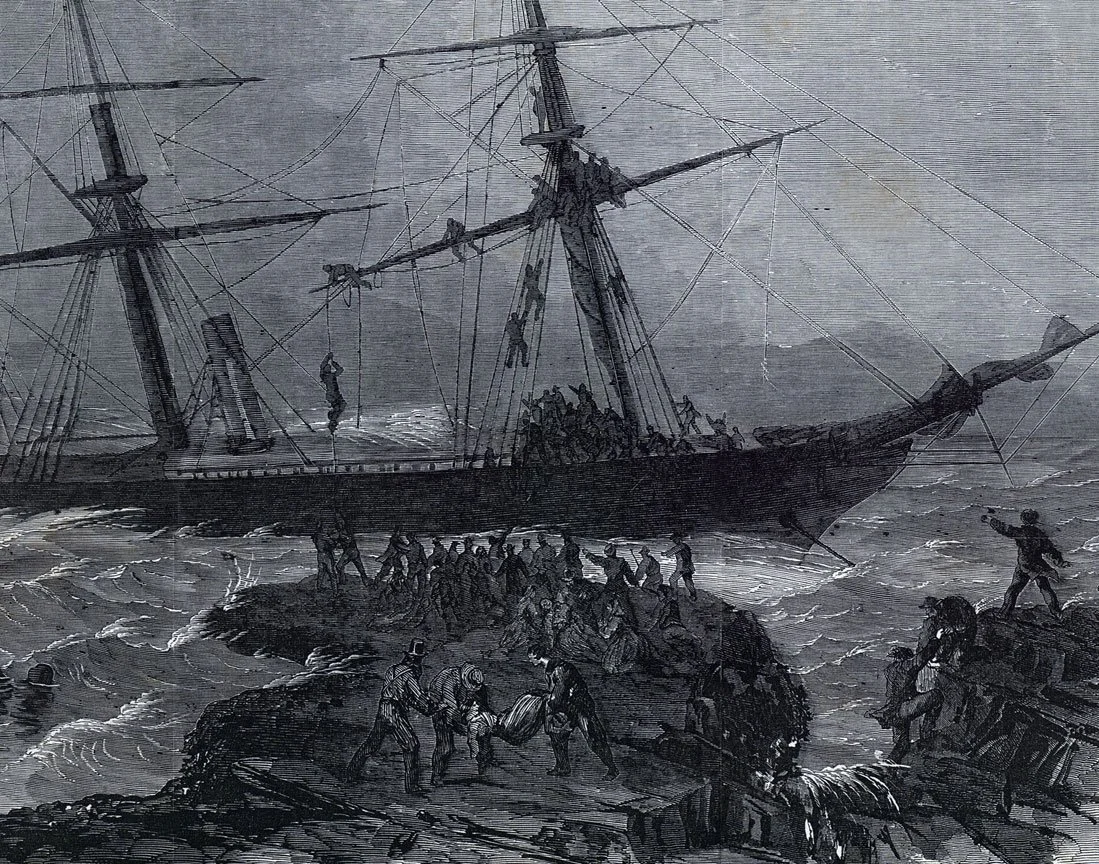
Wreck of the Anglo-Saxon off Newfoundland with heavy loss of life, 27 April 1863, nine years after this ship carried Elizabeth to Australia.
What followed was a turbulent decade that reveals as much about the instability of colonial life as about Elizabeth herself. In January 1855, barely months after landing, she married Robert Smith at Cook's River, near Sydney. The marriage did not last, or perhaps never fully took hold, because by 1856 she had married again—this time to James Franks in Sydney—very possibly while still legally bound to Smith. Apparently bigamy did not faze Elizabeth.
By July, her second husband Franks had placed notices in the Sydney Morning Herald declaring that Elizabeth had deserted him and that he would not be responsible for her debts. This was a common Victorian-era legal formula used by abandoned spouses and a small but telling window into a marriage that had already collapsed.
Divorce was virtually unobtainable for ordinary people in that period. The colonies had only just begun to legislate for it. So desertion, remarriage under an assumed name, and a quiet flight across colonial borders were the few alternatives available to people trapped, or on the run, or simply acting like scoundrels.
Whatever the reason for Elizabeth's flight, it eventually took her all the way to Tasmania, although how and when is unknown. There on Christmas Day 1858, now calling herself Elizabeth Edwards, she married for at least the third time to William Henry Cooper at O'Brien's Bridge outside Hobart.
This bigamous marriage was undertaken far enough from Sydney and under a changed name to escape immediate detection.
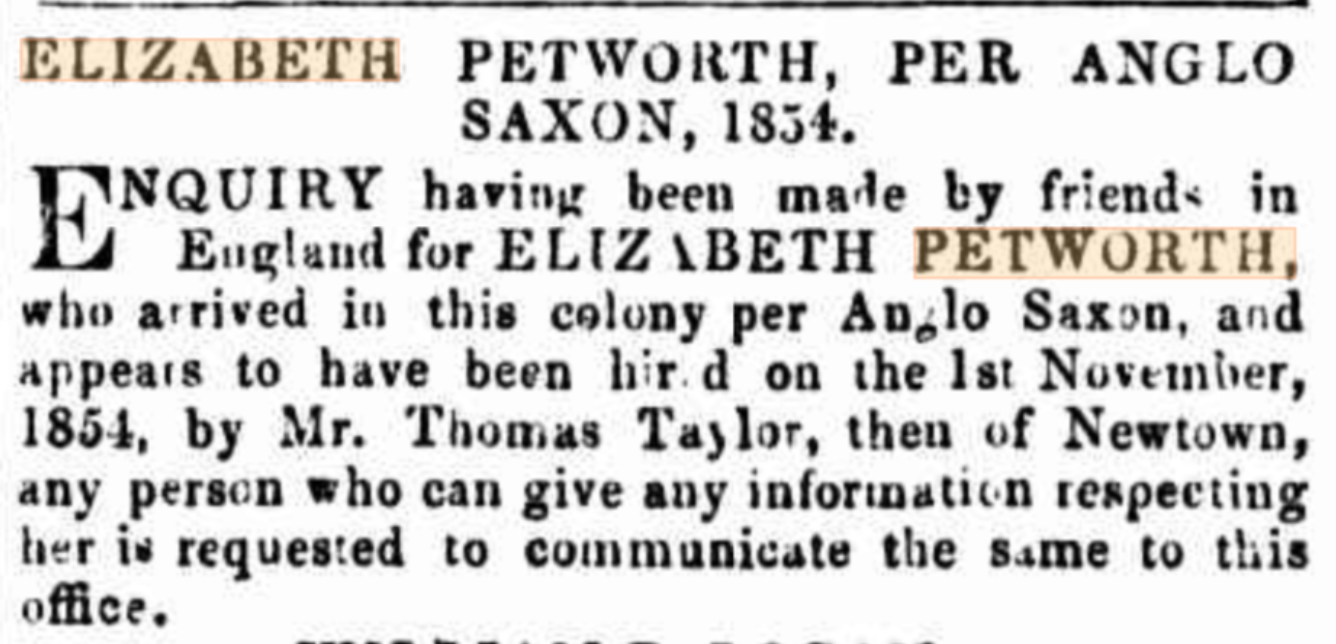
An a placed in the Freeman’s Journal Sydney on Wednesday 25 Sep 1861.
Over the next decade Elizabeth bore five children, settling into the ordinary rhythms of colonial family life in Hobart, even as her past remained obscured.
Meanwhile friends back in Sussex and Hampshire who had known her as Elizabeth Petworth had lost track of her entirely. In 1861 they placed appeals seeking her whereabouts in Sydney's Freeman's Journal and Empire.
Around the same time the colonial Government Immigration Office advertised for information on her location—a reminder of how completely an assisted immigrant could disappear into the vastness of the Australian colonies and yet how seriously the immigration authorities who had underwritten her passage still tracked their charges years later.

Elizabeth’s true surname, Petworth, appears for the first time in Tasmania in this 1865 birth record of her son Charles Henry Cooper.
And so she might have remained Elizabeth Cooper, née Edwards, forever—except in 1865, on the birth record of her son youngest Charles Henry, Elizabeth’s maiden name finally reappeared. Someone had found her and written in one of the ledgers in a small and shaky hand—noticeably different from the other handwriting on the form—her real name, Petworth.
On that ledger, she signed her name with an “X,” marking her own illiteracy. So whose hand wrote this mysterious clue to her real identity? Did Elizabeth divulge the truth willingly? Or had she been she found out at last and forced to reveal herself?
Whatever the case, she fought hard to maintain her deceit and her false name Elizabeth Edwards came down through the Cooper family, presenting a nearly implacable genealogical brick wall to future generations. But years of hard sleuthing through the online records eventually revealed her big, bigamous secret.
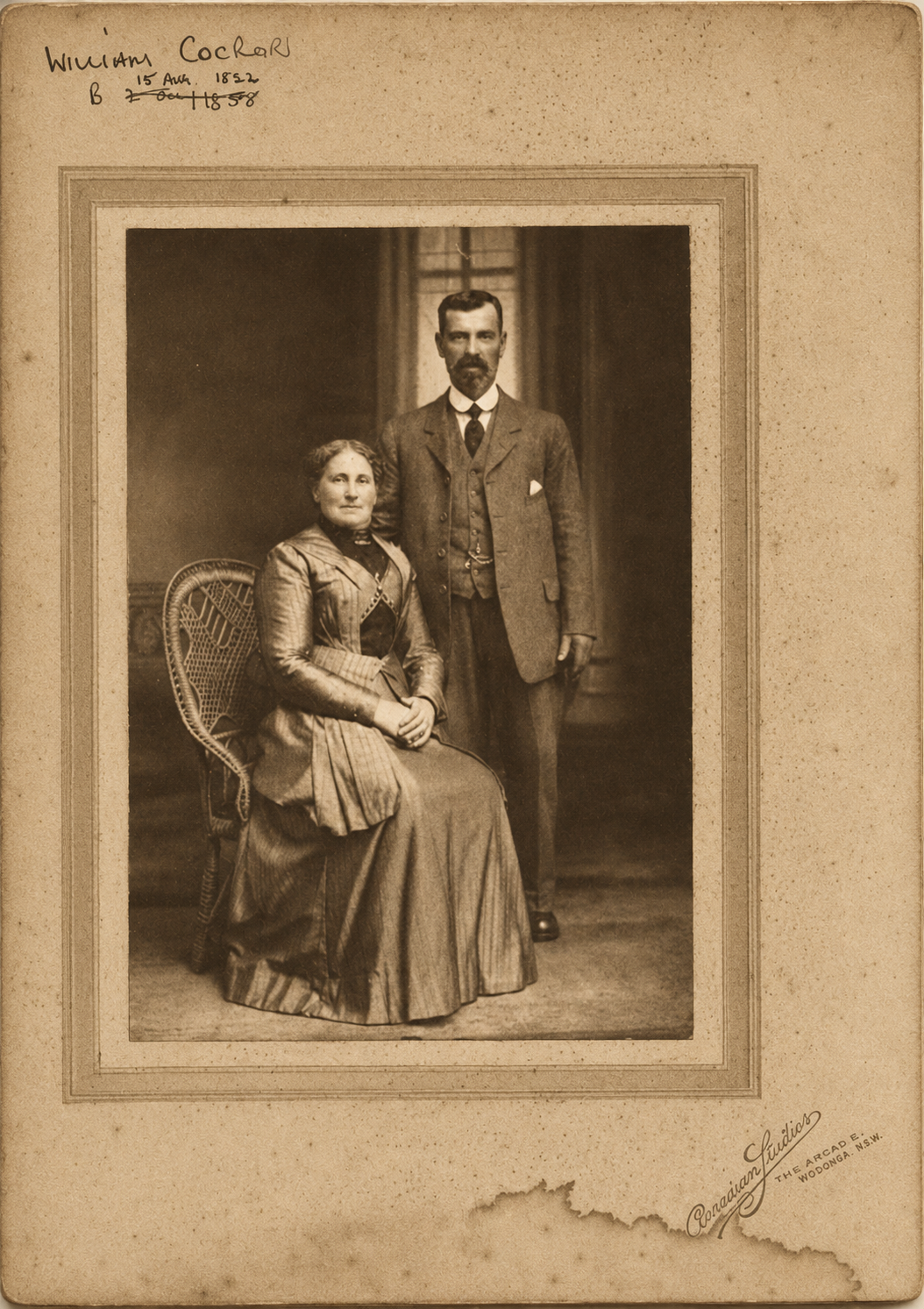
Elizabeth (Petworth) Cooper and William Henry Cooper, circa 1870.
Elizabeth Cooper, as she was known for the rest of her life, died on 15 June 1897 in Moonah, a Hobart suburb, and was buried in St John's Cemetery, New Town.
It was a quiet end for a woman whose early life had been shaped by the poverty of rural England, the demographic upheavals of the gold rush, and the bold and illicit strategies she had used to chart her own course in life.
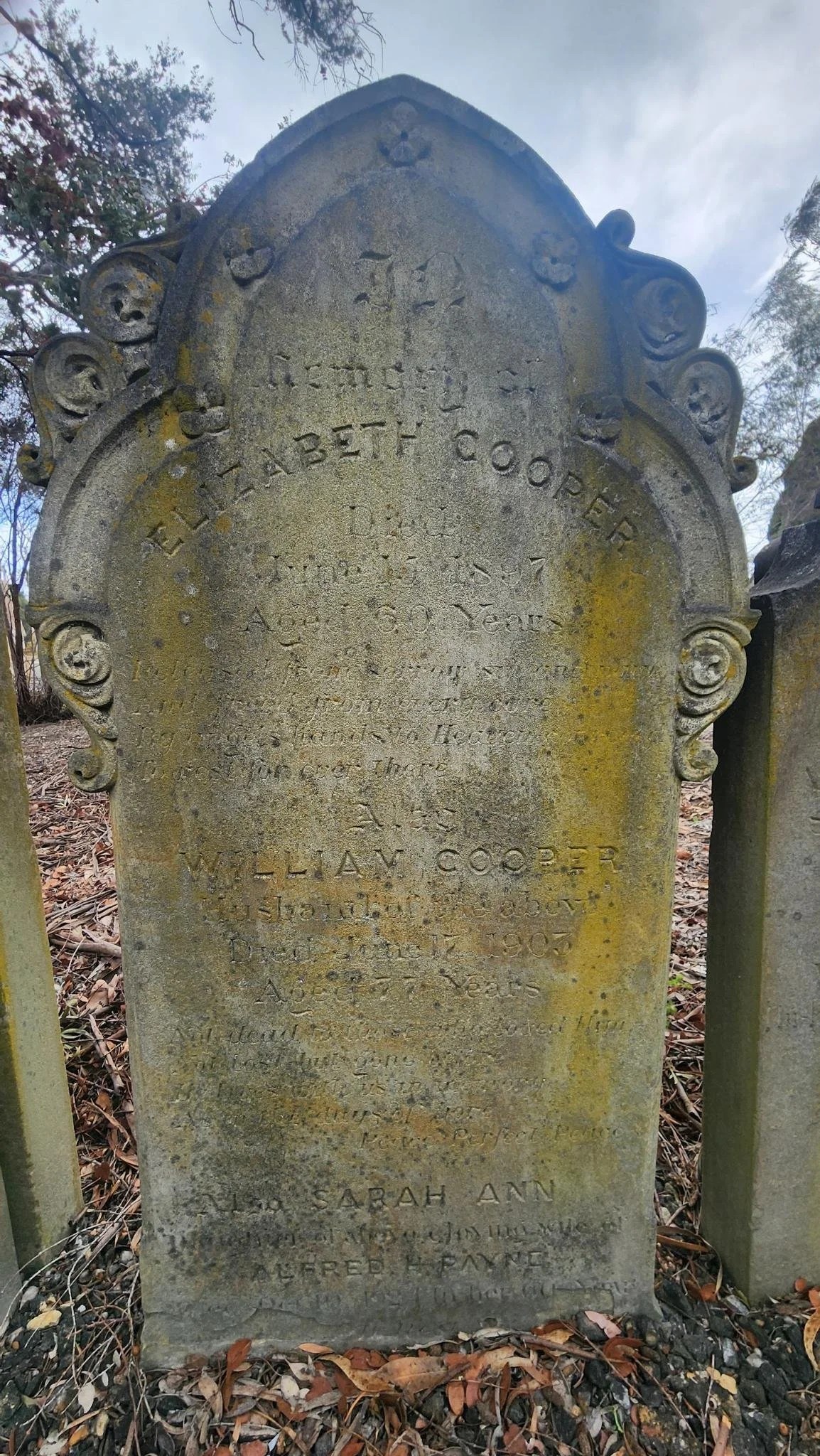
Elizabeth (Petworth) Cooper gravestone, originally in the St John’s Church graveyard, New Town, Tasmania, eventually moved to Cornelian Bay Cemetery, Cornelian Bay, Tasmania, Australia. Her husband William Henry Cooper shares the grave, as does their daughter Sarah Ann (Cooper) Payne and her husband Alfred Payne.