Thomas Rowley: Earliest Known Ancestor & the Oldest Brick Wall (c.1525-1608?)
Tenth great grandfather to Patience Jewell Whitty
So who is the oldest known ancestor on the Whitty-Jewell tree?
Thomas Rowley is listed as the father on the baptism record of Edward Rowley, dated 28 June 1555 from Keele, Staffordshire, England. Thomas, the father, was likely born about 1525, which makes him twelve generations removed from Patience Mildred Jewell, marking the terminal genealogical brick wall of her known tree.
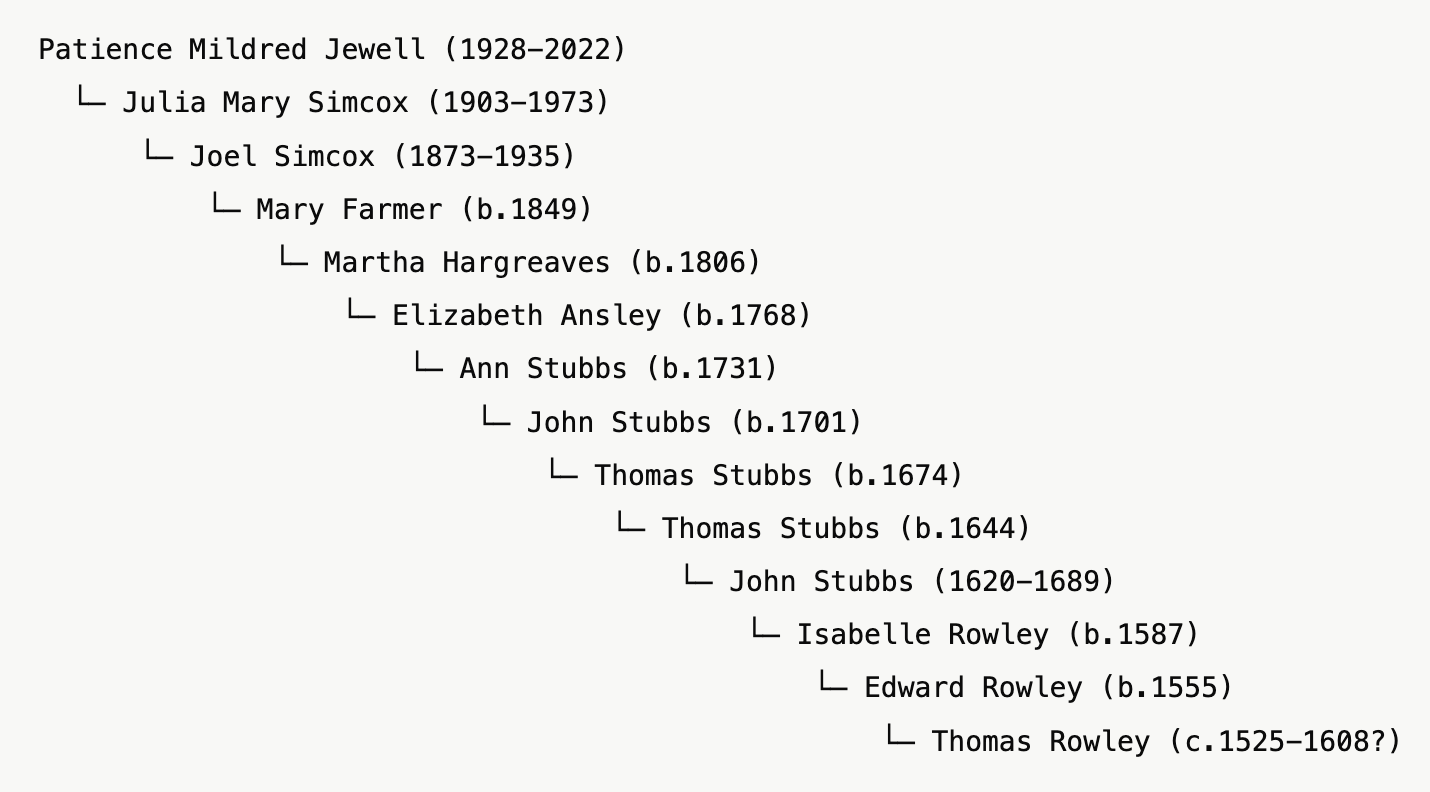
The ancestor chain linking Patience Jewell Whitty to Thomas Rowley (c.1525-1608?), from Keele, Staffordshire, England.
The ten oldest generations (above) all lived in and around the same parts of Staffordshire, where the Rowleys likely farmed, where later generations mined for coal, and where more recent generations worked in The Potteries, making ceramic-ware and English porcelain.
All of those occupations were brutal work with many attendant risks and consequently lifespans were shortened by them. The average lifespan at birth for a 16th century English farm worker was around 35 to 40 years. However if they survived the high infant and child mortality risks, they might expect to live into their 60s.
Ancestors in the family tree inhabited many villages on this 1577 map, including the village of Keele, just to the soutwest of Newcastle upon Lyme, noted as ‘Newcast’ in the center.
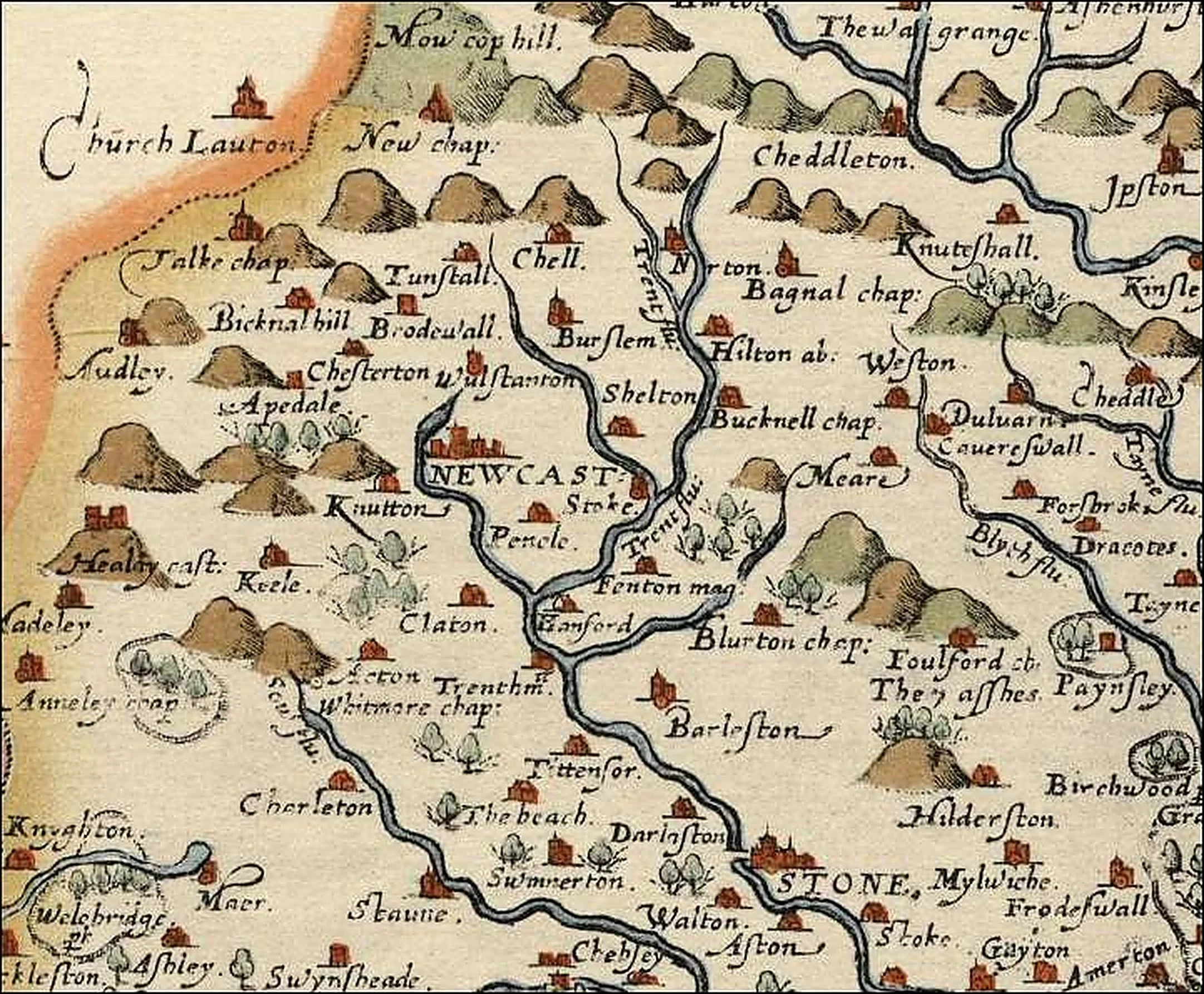
The Newcastle and Stoke-on-Trent area of North Staffordshire in 1577, Christopher Saxton. Keele is slightly southwest of Newcastle-under-Lyme (‘Newcast.’ here). These villages were home to the oldest ten generations of the tree (above).
So what was going on in the area when Thomas was born? In 1525 Keele was a tiny rural manor in north-west Staffordshire, a few miles west of the market town of Newcastle-under-Lyme.
Keele was a place of perhaps 100–200 inhabitants. The landscape consisted of scattered farmsteads, small crofts, open fields, woodland, and rough pasture rather than a nucleated village in the modern sense.
The landscape would have looked far more wooded than today, with hedgerows, commons, streams, and patches of heath covering the rolling sandstone hills.
_(cropped).jpg)
Staffordshire landscape today.
In 1525, Keele was in a period of transition. For over three centuries the manor had belonged to the Knights Templar—the elite medieval Catholic military order established in 1119 to protect Christian pilgrims traveling to the Holy Land.
Many of these pilgrims were wealthy people, travelling with enough money to support them for the long journey. This made them easy marks for thieves and highway robbers. The Templars organized to protect them and they were composed of an odd mix of knights who were ordained as monks, and monks who were knighted as warriors.

King Baldwin II presiding over a council on the left, the Knights Templar departing on the right
Over the centuries the Knights Templar evolved from warriors to hugely wealthy, innovative financiers for European royalty, more or less inventing the system of banking, before being dismantled amid false heresy charges in 1312.
After the suppression of their order, the Knights Templar ceded their lands to the Knights Hospitaller (Order of St John)—another ancient Catholic and chivalric order. Founded in 1113, they originated as a medical charity in the Holy Land before evolving into a formidable military force to protect Christian pilgrims.
The Hospitallers took over Keele, administering it through tenants and local officials rather than residing there themselves. For two centuries the folk of Keele worked on Hospitaller land.
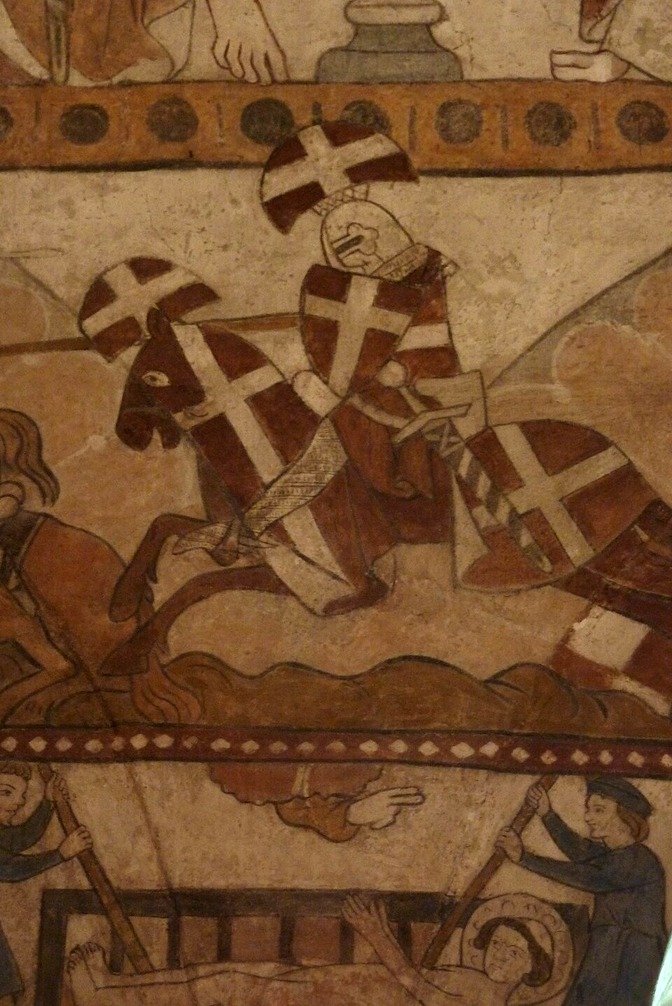
A Knight Hospitaller on a church wall.
Then in 1540 Henry VIII dissolved the religious orders. At that point the manor passed to the Crown, and in 1544 the Crown sold the estate of Keele, along with thousands of acres in surrounding areas like Audley and Chesterton, to Sir William Sneyd, for roughly £334.
Keele therefore became a ‘closed’ manorial village where all the land belonged to a single lord, and the population worked it as tenant farmers, smallholders, or laborers. There was no other industry of note yet (coal and ironstone mining on the estate became significant later).
So Thomas Rowley likely worked either as a tenant farmer—operating a large (~50 acres) holding and hiring laborers—or, more likely, as a smallholder—farming a tiny plot of land (typically 5-15 acres), relying on wage labor to survive. He may also have been only a laborer on other’s lands. Whatever the case, he probably worked the same land after the changeover from the Crown to Sir William as he had before.

The 16th century Keele Hall eventually went derelict and was torn down in 1851. This is the rebuilt Keele Hall, Staffordshire, England, 1880 (engraving).
Byt the time Thomas’ son Edward married Joan Kendall in 1580, Sir William’s son Ralph Sneyd was building the first Keele Hall (started c.1580–81) half a mile from the village. So Edward's marriage and the Hall's construction were essentially simultaneous and he would have watched it go up and quite possibly worked on the building of it.
Most likely both Rowleys were tenant farmers or husbandmen working strips of arable and pasture land under the Sneyd manor, practicing mixed farming, some livestock, and dairying, which was becoming more important in this part of Staffordshire from the 17th century on. If either was landless.
It’s possible more could be discovered about the Rowleys’ actual status in 16th century Staffordshire society by investigating in person a Sneyd estate memorandum—’item 1580,’ the ‘descent of title’ document naming a Rowley family among the freeholders of the Sneyd estate—located in the Keele Special Collections. If that document turned out to concern Keele village rather than the Derbyshire property the Sneyds also owned, it would put a Rowley holding land in freehold, not just as a tenant—which would mean Thomas Rowley’s life was meaningfully different than life as a ‘labourer.’