Ellen Manahan: From the Irish Famine to ‘Marvelous Melbourne’ (c.1848-1911)
Grandmother to Mark Stephens Whitty
Ellen Manahan was born around 1840, likely in Knocklong, near Ballylanders, a small parish in County Limerick, Ireland where her parents were married. Within a few years of her birth her family would find itself at the near epicenter of the Great Irish Famine.
The years of 1845 to 1852 devastated Limerick as thoroughly as almost anywhere in Ireland, wiping out the potato crop that rural families like the Manahans depended on for subsistence, filling the county's workhouses, and driving a wave of emigration that would not fully subside for decades.
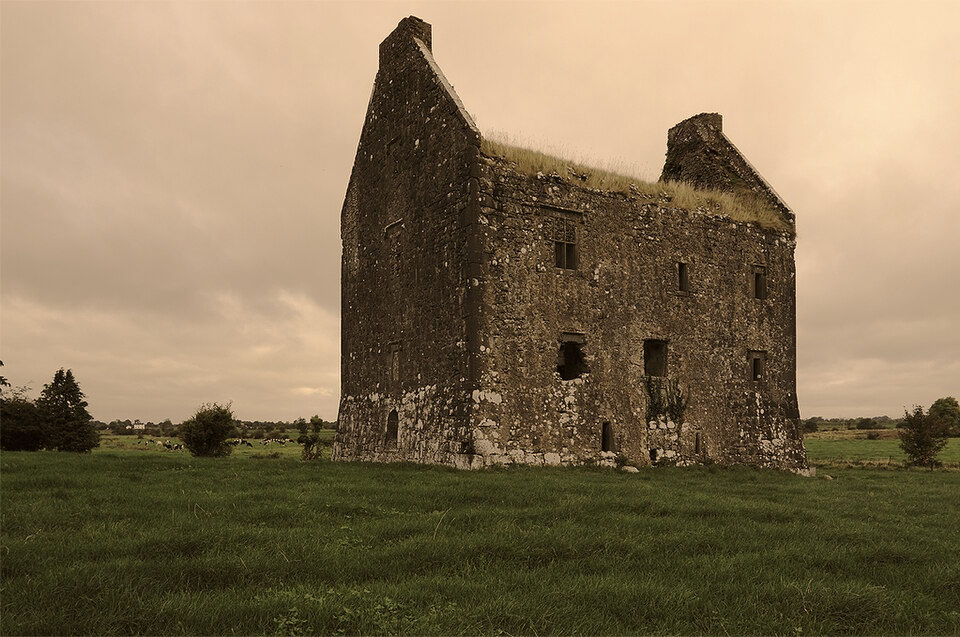
Ruins of a castle near Knocklong, County Limerick, Ireland, the village where Ellen’s parents were married and where she was likely born.
Charles Trevelyan, who was in charge of the administration of government relief, chose to limit the Government's food aid program, claiming that food would be readily imported into Ireland once people had more money to spend after wages were being paid on new public-works projects. Thus he turned a famine into a genocide. In a private correspondence, he explained how the famine could benefit the English colonial powers by repopulating the country with landowners more favorable to the Crown. As he wrote to Edward Twisleton:
“We must not complain of what we really want to obtain. If small farmers go, and their landlords are reduced to sell portions of their estates to persons who will invest capital we shall at last arrive at something like a satisfactory settlement of the country.”
During the Great Hunger roughly one million people died and over one million more emigrated. The population dwindled from approximately 8.5 million people just before the famine to 4.4 million by 1901. Even now Ireland’s numbers have not recovered to pre-famine levels.
John Mitchel, a leading Irish nationalist of the time, wrote one of the first widely circulated tracts on the famine, published in 1861. He was convicted by a jury under the newly enacted Treason Felony Act and sentenced to 14 years transportation to Bermuda. Yet one sentence he wrote has since become famous:
“The Almighty, indeed, sent the potato blight, but the English created the Famine.”
_-_Irish_Famine_-_COMWG_132_-_Watts_Gallery.jpg)
Irish Famine, George Frederick Watts, 1850.
Ellen would have been only a small child during the worst of the famine years, but she grew up in its long shadow in a Limerick countryside permanently emptied of population. Emigration to England, the US, and Australia had become less an exceptional choice than an ordinary expectation for young Irish men and women, since only starvation, eviction, and death faced them at home.
By the time Ellen, aged eighteen, sailed from Liverpool, lthe great departure port for Irish emigrants, she was joining one of the largest sustained migrations in the empire's history. Australia, and Victoria in particular, had spent the 1850s and 1860s absorbing enormous numbers of assisted immigrants.
This policy was initially driven by the labor shortages of the gold rush that began in 1851 and sustained afterward by the colony's ongoing demand for domestic servants and marriageable women.
In a colonial population still heavily skewed toward men, single women, often Catholic and often from famine-scarred counties like Limerick, made up a significant share of these bounty passengers, filling a niche the colonial authorities considered essential to building a stable settler society.
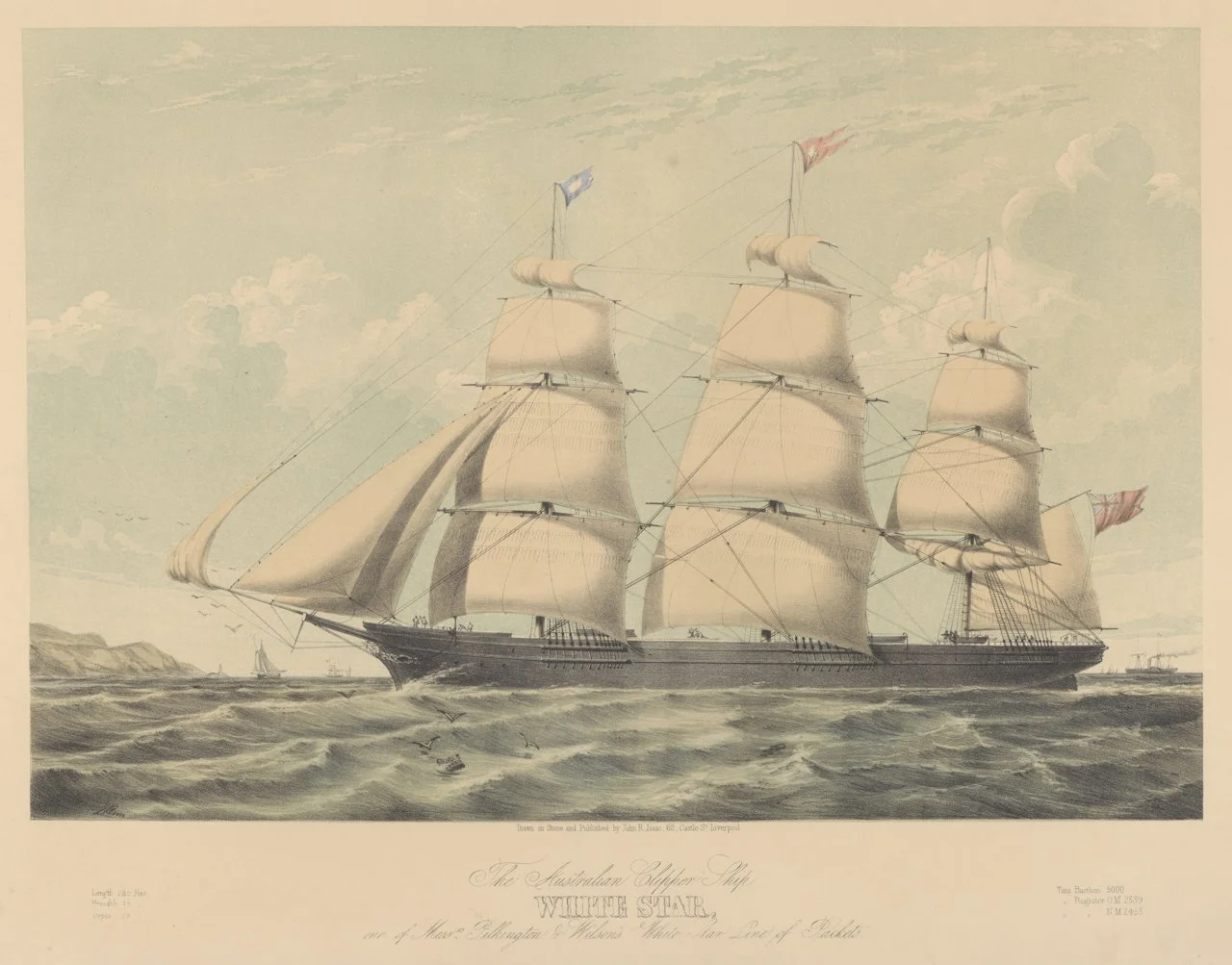
The Australian clipper ship White Star, upon which eighteen-year-old Ellen sailed to Victoria in 1866.
Ellen sailed aboard the famed American-made Australian clipper ship White Star, for which the Titanic’s shipping line would later be named. They departed Liverpool 3 May 1877 and arrived Melbourne 30 July 1866 after a voyage of only 88 days—proving the speed of these clipper ships, since many earlier voyages on slower ships took one hundred thirty or more days to cover the distance.
Ellen settled in Melbourne, where in 1873 she married James Francis Whitty., the son of an original Australian pioneer who left his father’s remote rural Victoria cattle station for city life. Ellen and James’ lives together collided with the booming Melbourne of the 1870s and 1880s, a city then in the midst of its ‘Marvellous Melbourne’ era, flush with gold-rush wealth.
The couple got into the business of hotels and their more lucrative sidekicks, pubs. Over the years they owned a variety of such establishments, starting in 1858, when James was granted a publican's license to serve alcohol at the Governor Barkly Hotel in Woodstock, Victoria—often referred to as Whitty's Woodstock Hotel. In 1874 he and Ellen were granted a license for the Golden Fleece Hotel in Melbourne, and in 1881 he bought the Britannia Hotel, Swanston St. Melbourne. At the time of his death in 1896 he ran the Retreat Hotel at Hampton.
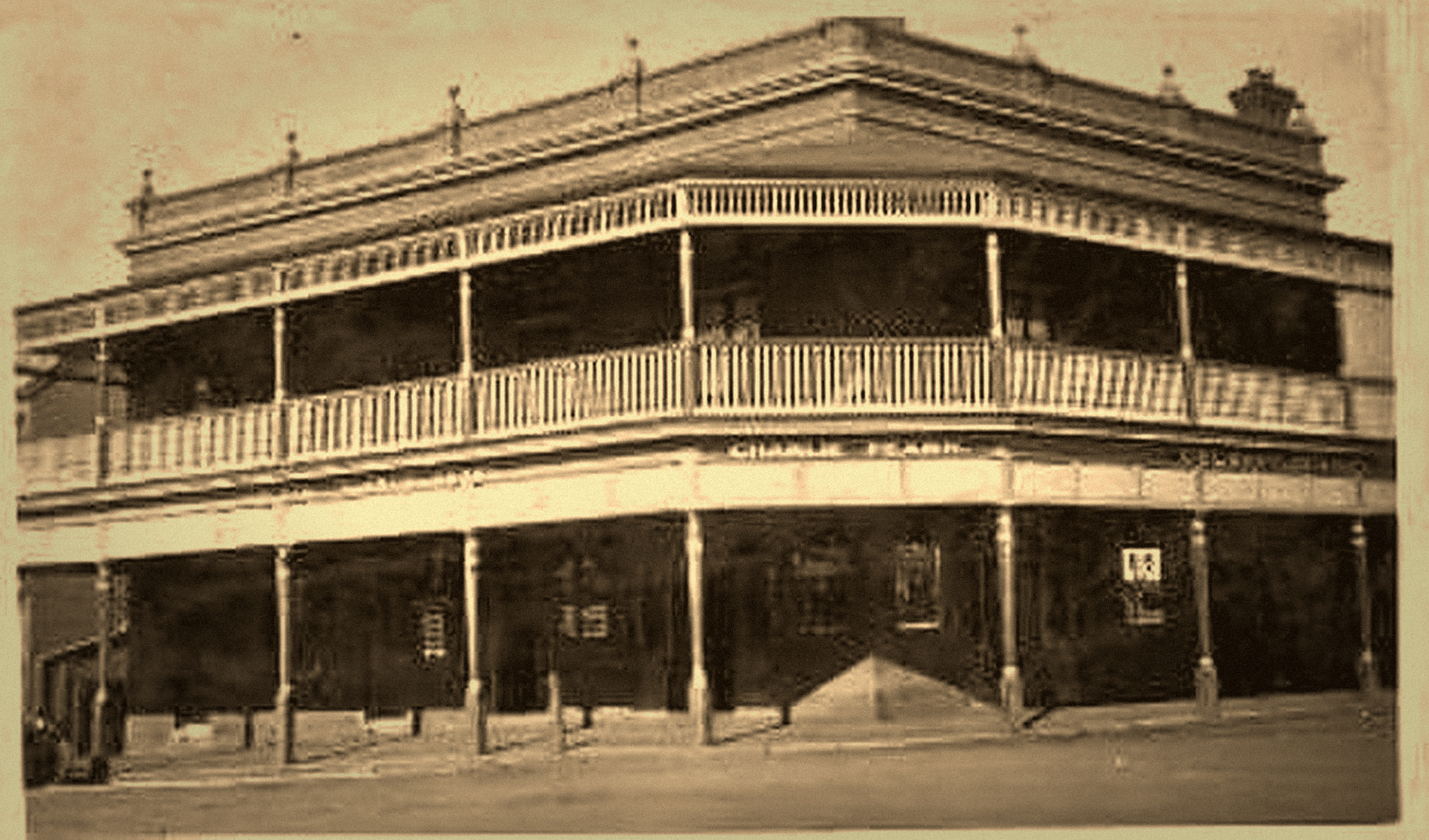
The Golden Fleece Hotel, Melbourne, which Ellen and her husband James Whitty were licensed to run in 1874.
Together Ellen and James had at least five children, starting with Francis James, then Kate Parnell, William John, Mary Victoria, and Mark Raymond.
In 1896, when her youngest was only eight years old, Ellen’s husband James died suddenly at the age of fifty-two. His birth certificate recorded his cause of death as delirium tremens, reputedly from having drunk too much of his own product in his own pubs, where he was also said to dance a memorable Irish jig.
A surviving photograph shows Ellen with her son Mark Raymond Whitty taken after James’ death, one of the few personal images to survive from a life otherwise documented mostly through official paper.
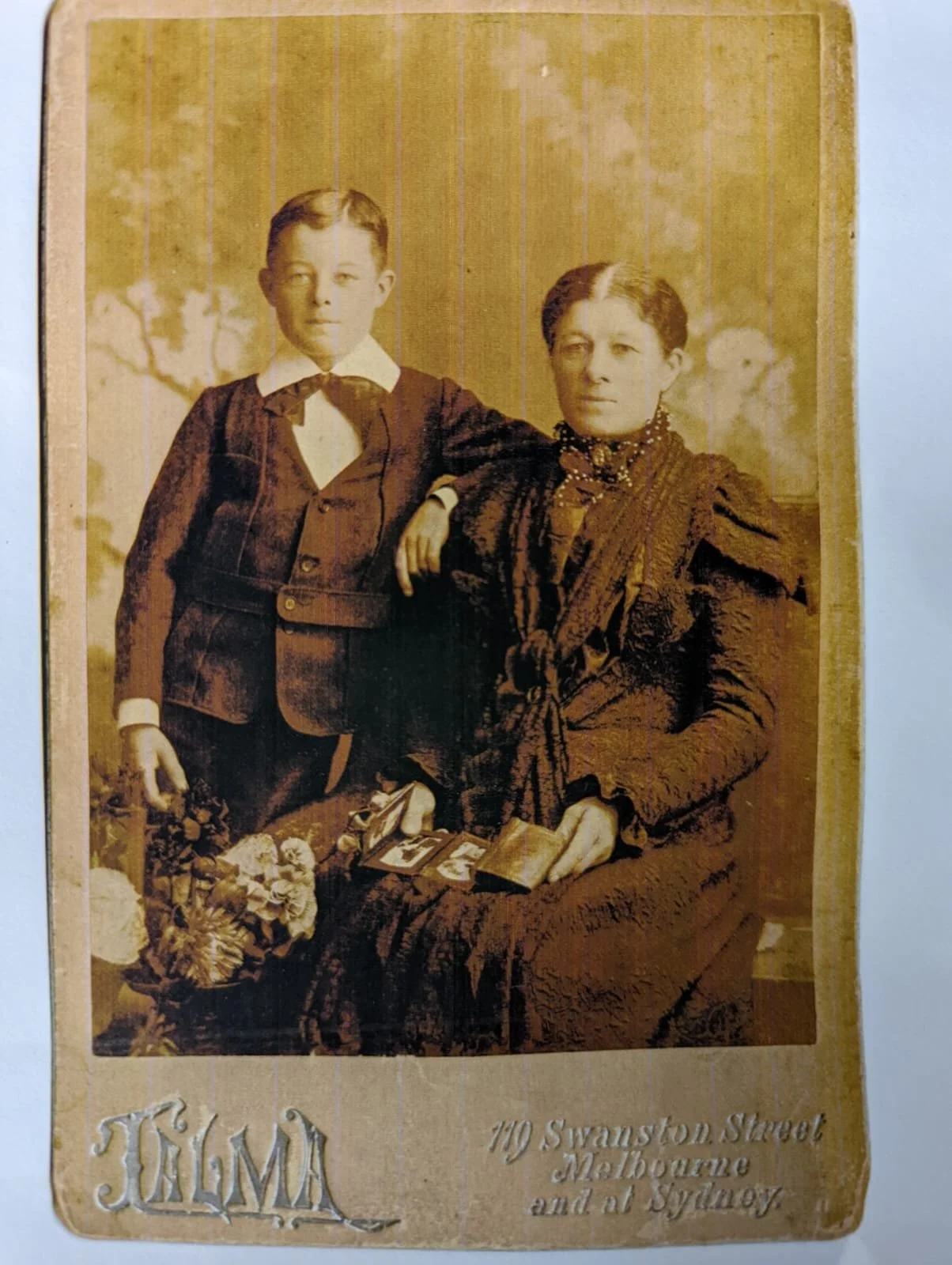
Mourning portrait of Ellen (Manahan) Whitty and her son Mar Raymond Whitty after the death of her husband and his father, Francis James Whitty. Ellen is holding his portrait photographs.
Widowhood in colonial Victoria could be precarious for a woman on her own and Ellen's file includes several records from the Court of Petty Sessions in Footscray—the everyday local magistrate's court that handled the ordinary disputes, debts, and domestic troubles of colonial working people. Mostly she was cited for selling alcohol on Sundays.
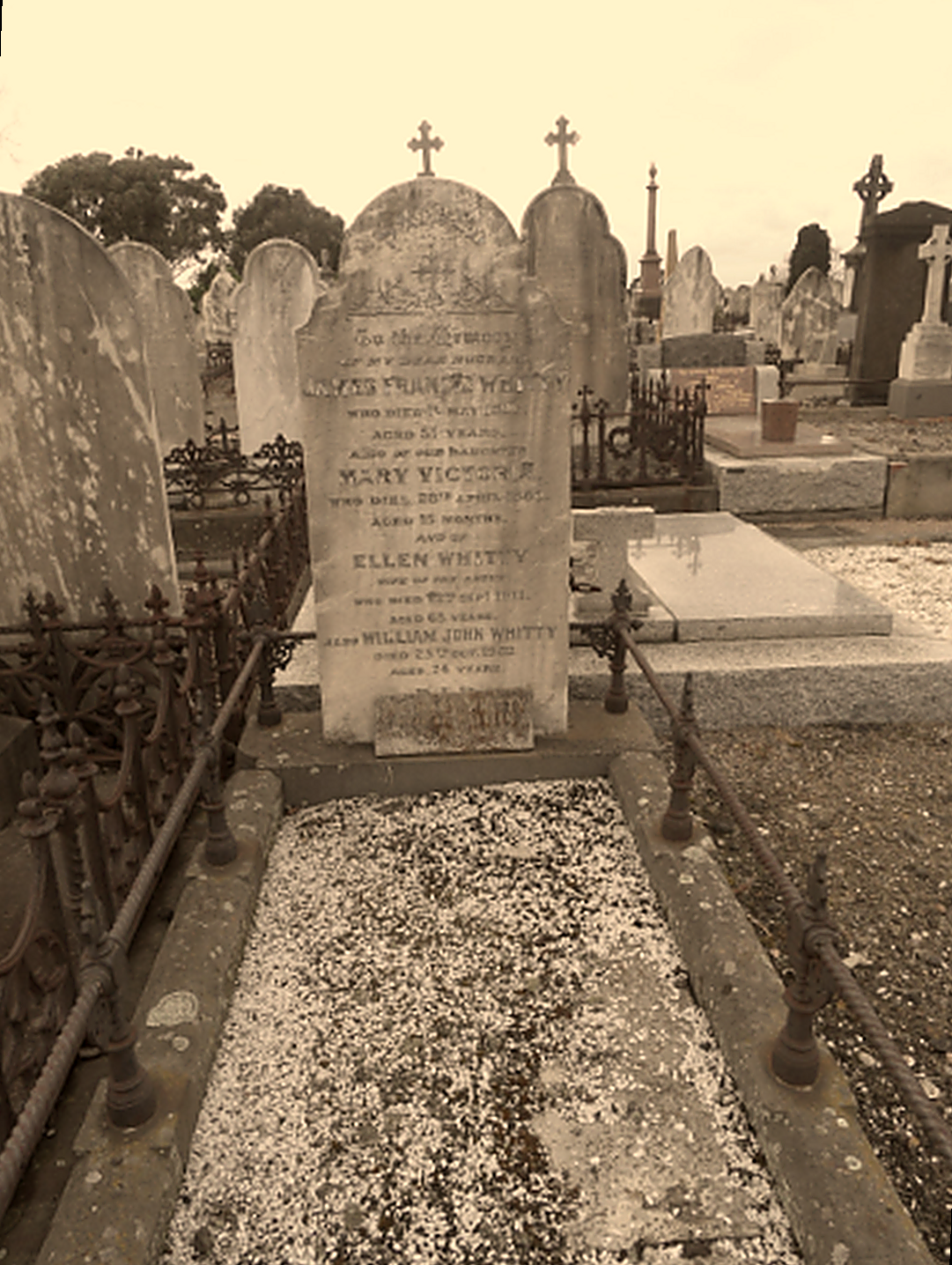
Ellen Manahan Whitty died in Brighton, Victoria on 22 September 1911, aged about 63 years. Her life closed out where her family's grave now stands in the Melbourne General Cemetery in Carlton, alongside her husband James, her son William John Whitty, and her daughter Mary Whitty.
The shared headstone marks a family that had within the space of a generation gone from a famine-stricken Irish parish to a permanent place in one of colonial Australia's great emerging cities. It also marked one of the defining demographic transformations of the nineteenth-century: the emptying of famine Ireland and the filling of a raw new settler colony on the other side of the globe.