William Eate: Twenty Years a Redcoat in Bengal (1781- ?)
Third great grandfather to Patience Jewell Whitty
William Eate was born on 9 February 1781 in Spalding, a fen-edge market town in the ‘Parts of Holland’ district of Lincolnshire. His father James was from nearby Doddington, Cambridgeshire, both places sitting in the drained fenland along the River Welland.
This region had spent the previous century and a half being systematically transformed from marsh into farmland through large-scale drainage schemes. By the time William's father was born around 1748 the family would have been living in a landscape only a generation or two removed from active fen reclamation.
Prior to the drainage of the fens, people here mostly fished and fowled for a living. But after the drainage Lincolnshire's population grew rapidly and the Fens with its common rights and small farms absorbed most of the increase. The reclaimed fen soil around Spalding was exceptionally fertile, producing very heavy crops of wheat and corn, and fattening livestock with peculiar ease.
_-_Mills_on_the_Fens_-_NWHCM_,_1947.172.2_,_F_-_Norfolk_Museums_Collections.jpg)
Mills on the fens, Henry Bright.
What did William’s family do to support itself? Spalding functioned as a farming and market hub, and for an ordinary family without land or capital that likely meant working as day-laborers or smallholder tenants—ploughing, harvesting, tending livestock, and maintaining by hand the drainage ditches, dykes, culverts, ponds, and farm tracks that kept the reclaimed land farmable.
Alternately, Spalding was a market town and inland seaport and in its heyday as a river port in the 18th century it provided the town with its most elegant streets, built on trade carried along the River Welland. If William’s father moved from Doddington to the town itself they might have been connected to that river-borne trade, as carters, boatmen, or market workers. Country folk came into town for the market every Tuesday and Saturday, as they had for centuries, to buy and sell wares.
Whatever the family work, after his father’s death in 1799, eighteen-year-old William immediately enlisted as a private in the 1st Battalion of the 17th (Leicestershire) Regiment of Foot, commonly known as the 17th Foot. Did he want to see the world? Or was he conscripted to fight the nascent Napoleonic Wars?
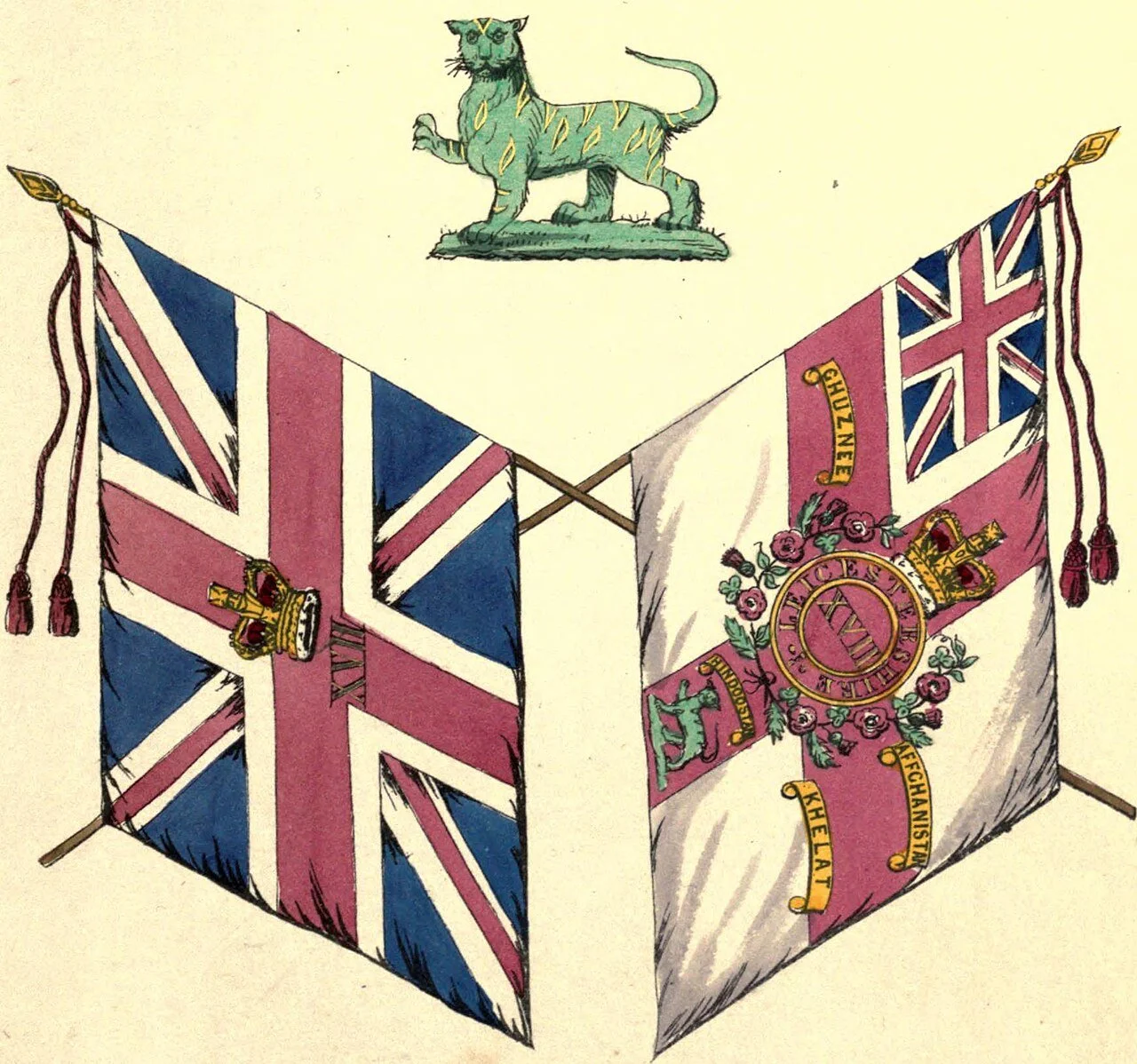
Colours of the 17th (Leicestershire) Regiment of Foot.
Little did he know how much of the world he would see. The 17th Foot fought the French Revolutionary Army in the Netherlands in 1799, then settled into garrison duty at Minorca in the western Mediterranean, a fortress island Britain prized as a naval base guarding the approaches to the Mediterranean. From there they went to Madeira, then Ireland, and in July 1804 they sailed for India, arriving at Fort William, Calcutta, in December.
The 17th Foot was one of many King's regiments the Crown sent out to reinforce the East India Company's own private armies, as Company territory was expanding rapidly under the aggressive colonizing policies of Governor-General Wellesley and his successors in the years around 1800.
What followed for William was, by any measure, a remarkably long and active tour of frontier soldiering. The regimental record credits the 17th with fighting at Bundelkund in 1807, on the Sutlej in 1808, against the Gurkhas on Nepal's difficult mountain frontier in 1813–14, and in the operations to relieve Nagpore in 1817. This chain of campaigns traces almost exactly the piecemeal, decade-by-decade consolidation of British power across northern and central India in this period.
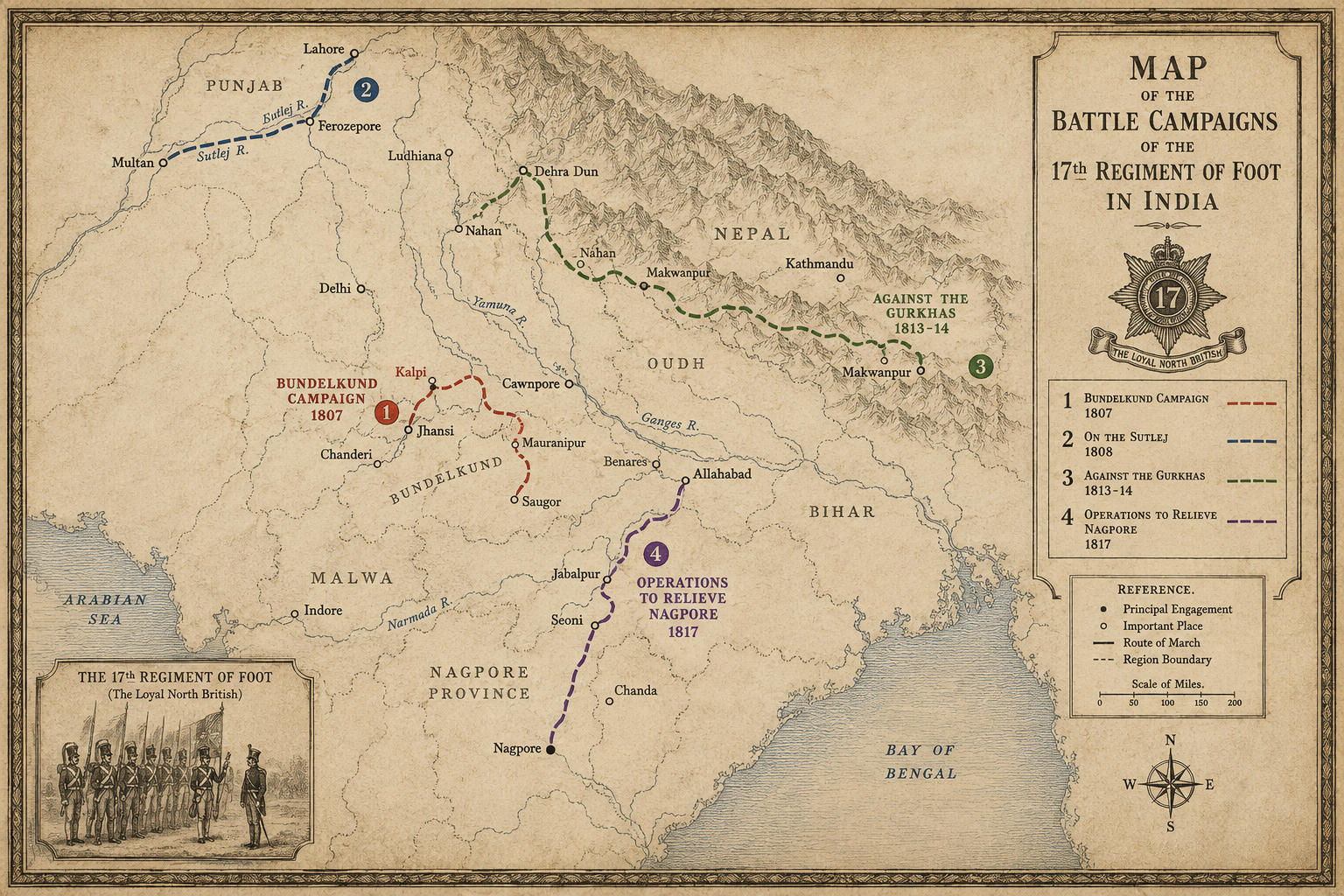
The Anglo-Nepalese War in particular was a brutal education for British troops more accustomed to open-field tactics. Gurkha forces fighting from fortified hill positions inflicted serious losses before the campaign ended in a treaty that first brought Gurkha soldiers into British service.
William, promoted to Corporal by 1814 and Sergeant not long after, was likely present for some or all of this fighting—a marker of just how physically demanding and geographically scattered ‘service in India’ was in reality for an ordinary redcoat of this era.
These campaigns covered territory from the plains of Bengal to the Himalayan foothills, and from the jungles of Nagpore to the rocky hills of the Bundelkund and beyond.
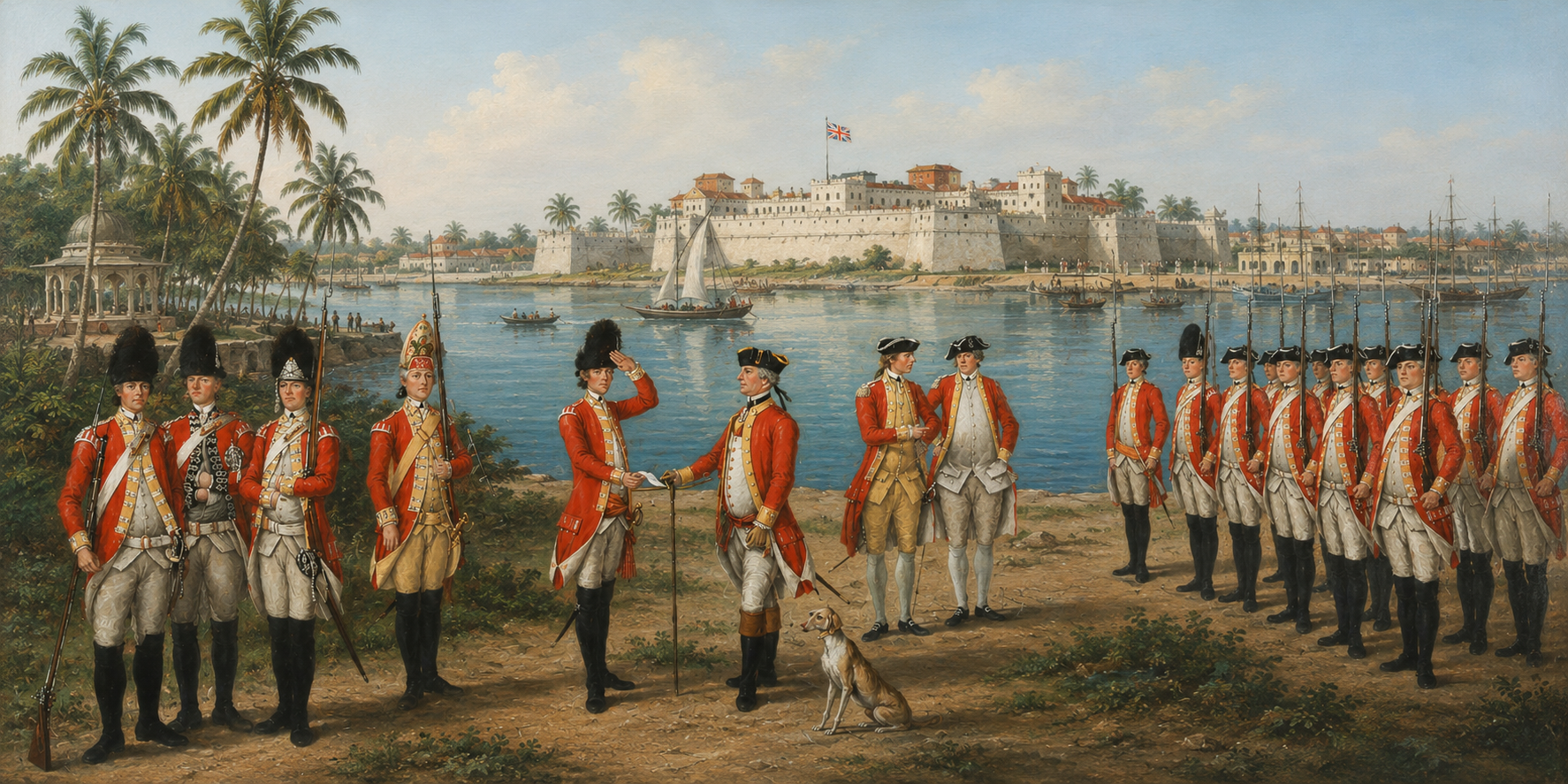
Redcoats in India.
Somehow William survived—the battles, the diseases, the forced marches, the rough living of military life. Whatever comforts he might have enjoyed were probably few and far between over nearly two decades in India and about a quarter century or more with the 17th Foot.
He likely fathered children all along the way, although none are claimed by him in any surviving records until late in his time in India, when he was stationed at Fort William in Calcutta, and at Berhampore, the regiment's up-country cantonment in Bengal. There between 1819 and 1821 Sergeant Eate fathered at least three children—Margaret, Elizabeth, and James (the surnames of some of these children later became Eates).
No mother's name appears on any of their baptismal records and the entry in James's 1821 baptism registry explicitly notes his birth as ‘illegitimate.’ This label was applied virtually automatically in this period whenever the mother of a British soldier's child was herself either Indian or Eurasian rather than European—regardless of the marital status of the couple. Hence most Eurasian children were declared illegitimate.
Such was the ordinary, largely undocumented domestic reality behind thousands of British soldiers' postings in India—long-term relationships and families that colonial record-keeping chose not to formally recognize.

Even sadder, British military men, officers and troops alike, had their children taken away at about the age of five from the non-European mothers who were raising them, and placed in orphanage schools, where they were taught English, reading, writing and arithmetic, and raised as Christians.
Many never saw their mothers or even their fathers again. The boys were trained to become, at about age fourteen, medics or apothecaries in the East India Company armies, or to become military bandsmen—the trumpeters, drummers, and fifers who musically relayed orders to the troops in the deafening heat of battle. The girls were prepared for arranged marriages as early as twelve with the older medics and bandsmen.
In this way the British East India Company produced exactly the kind of Eurasian community it wanted, an underclass caught between British and Indian societies, acknowledged by blood but not by law.
By 1823, after nineteen years in India, the 17th Foot was finally recalled to England. William Eate's own trail simply stops here. Many soldiers of the regiment chose to stay behind rather than return to a country they'd left as young men. Was William among them? Or did he stay on in this faraway home?
What is known is that the regiment itself was honored on its return. In 1825 King George IV granted the 17th the right to bear the badge of the ‘Royal Tiger’ on its colors in recognition of its long and distinguished service in India—service that for William had been earned in the most literal sense, through countless miles on foot in wool uniforms, from Himalayan siege lines to Nagpore jungles rife with wild tigers and elephants to blisteringly hot Bengali cantonments along the banks of the great Ganges River.
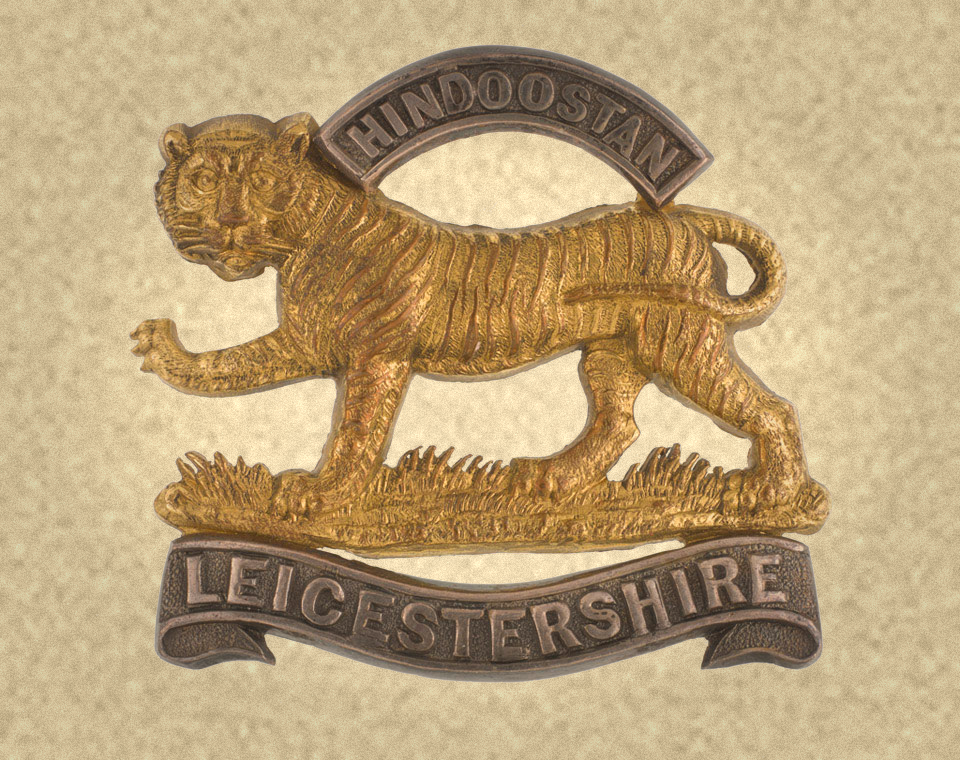
The 17th Regiment of Foot’s Royal Tiger badge.