John Cooper: From Highway Robbery to Javelin Man in Tasmania (1805-1888)
Second great grandfather to Mark Stephens Whitty
John Cooper was born on 26 April 1805 in Salford, on the very doorstep of Manchester, the town that more than any other was synonymous in those years with the Industrial Revolution. During his childhood the cotton mills of Manchester and Salford had transformed the district from a scattering of villages into the fastest-growing industrial region in the world.
John's own trade reflected that transformation. His convict record lists his occupation as calico printer, a skilled but notoriously volatile job stamping patterns onto the cotton cloth that Lancashire's mills produced by the millions of yards. Calico printing was one of the era's boom-and-bust trades, prone to sudden layoffs whenever fashion, trade tariffs, or a slump in cotton supply disrupted demand.

Calico printing, 19th century.
John’s convict record noted two prior convictions before his transportation to Australia in 1823. One one was for a three-month sentence and one was for a twelve-month sentence, both for unspecified offenses. These convictions hint at a young man already cycling in and out of poverty and petty crime well before his major conviction.
Economic insecurity for working people at that time and place was the norm and that insecurity came to a head for John on the night of 27 October 1822, when he, Enoch Lowe, and John Gee robbed a clerk named Joseph Edward Roberts on the highway near Wigan, dragging him from his horse and stripping him of his watch, a purse with eight sovereigns, and other property. John was caught shortly thereafter drinking up his ill-begotten gains at a local public house.
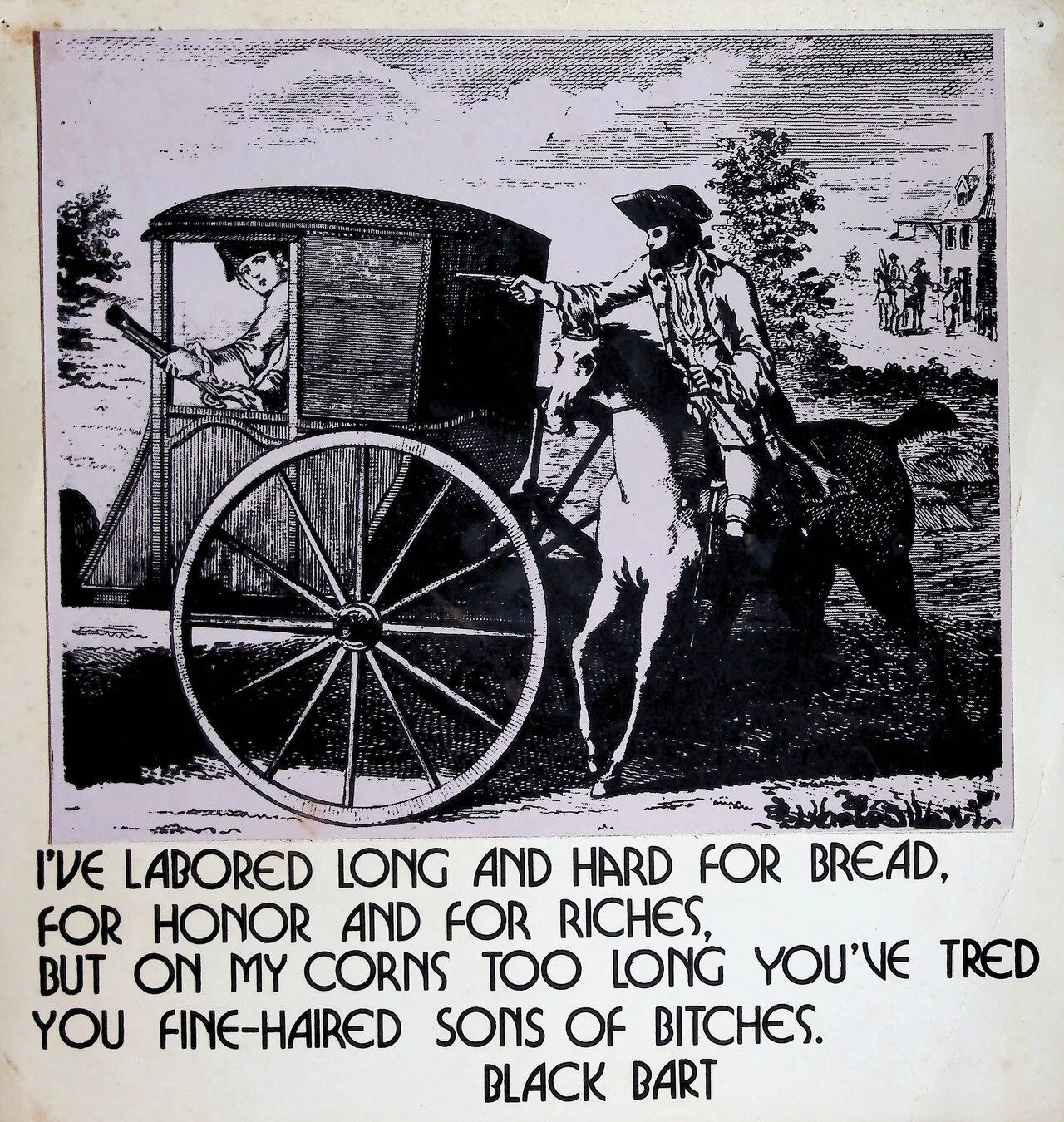
A highway robbery, with a poem by the notorious English-American outlaw, Black Bart, who often left poetry in the wake of his crimes.
All three men were found guilty at Lancaster Assizes in March 1823 and sentenced to death. This was the mandatory sentence for highway robbery under Britain's notoriously severe ‘Bloody Code’ of criminal law, which by the early nineteenth century punished dozens of property crimes, even minor ones, with hanging.
But in this time most such death sentences for property crime were commuted, and John's was no exception. Instead of the gallows, he was sent to the prison hulk Retribution, moored at Woolwich. Retribution was one of the largest and longest-serving hulks. Of all the hated hulks, prisoners dreaded Retribution most. It held nearly 600 shackled men in conditions of filth, violence, and disease so severe that the death rate aboard was more than double that of other hulks.
James Hardy Vaux, a notorious 19th-century thief and swindler who was transported three times to Australia described the conditions aboard Retribution thus:
“There were confined in this floating dungeon nearly 600 men, most of them double ironed; and the reader may conceive the horrible effects arising from the continual rattling of chains, the filth and vermin naturally produced by such a crowd of miserable inhabitants, the oaths and execrations constantly heard amongst them… On arriving on board, we were all immediately stripped and washed in two large tubs of water, then, after putting on each a suit of coarse slop clothing, we were ironed and sent below; our own clothes being taken from us. I soon met many of my old Botany Bay acquaintances, who were all eager to offer me their friendship and services, that is, with a view to rob me of what little I had; for in this place there is no other motive or subject for ingenuity. All former friendships are dissolved, and a man here will rob his best benefactor, or even messmate, of an article worth one halfpenny.””
It was on ships and hulks like this one that Britain warehoused the human overflow of its own industrializing cities, men whose economic desperation was treated by the era's rigid laws as pure criminality. The aptly named prison hulk Retribution was moored on the Thames close to the Woolwich Arsenal where its inmates were forced to labour while they waited to be transported to Australia.
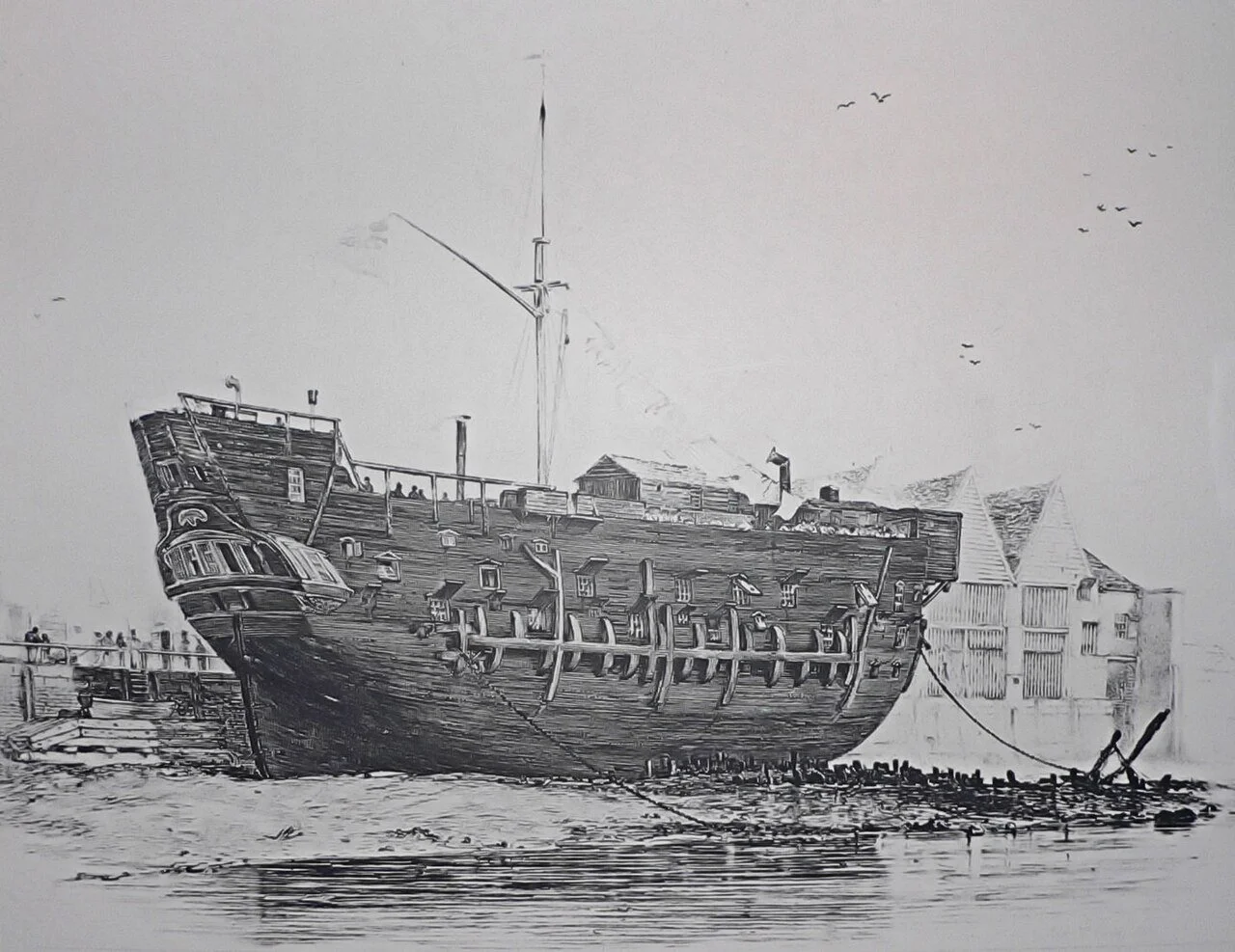
Prison Hulk in Britain, 19th century.
Morbidly, in spring and summer Retribution was a popular destination for tourists curious to view its awful carcass and its infamously depraved inmates. From the safety of small boats they could also observe 'the multitude of convicts in chains' working ashore during daylight hours.
The prisoners slept on straw and subsisted on 'barley and putrid meat,' which gave them such serious bowel problems they were sure it would soon 'terminate their miserable existences.' No officers dared descend among them after dark, despite numerous reports of robbery, murder, rape, and suicide. Several attempts to seal off each of the three lower decks to reduce the incidence of crime and disease had failed because the convicts tore down the carpenters’ work every night. Efforts to erect a chapel on board were equally unsuccessful.
During the three-and-a-half months that John Cooper was aboard Retribution his convict conduct record revealed his behavior aboard to be "Very Disorderly.” Was any man’s not?
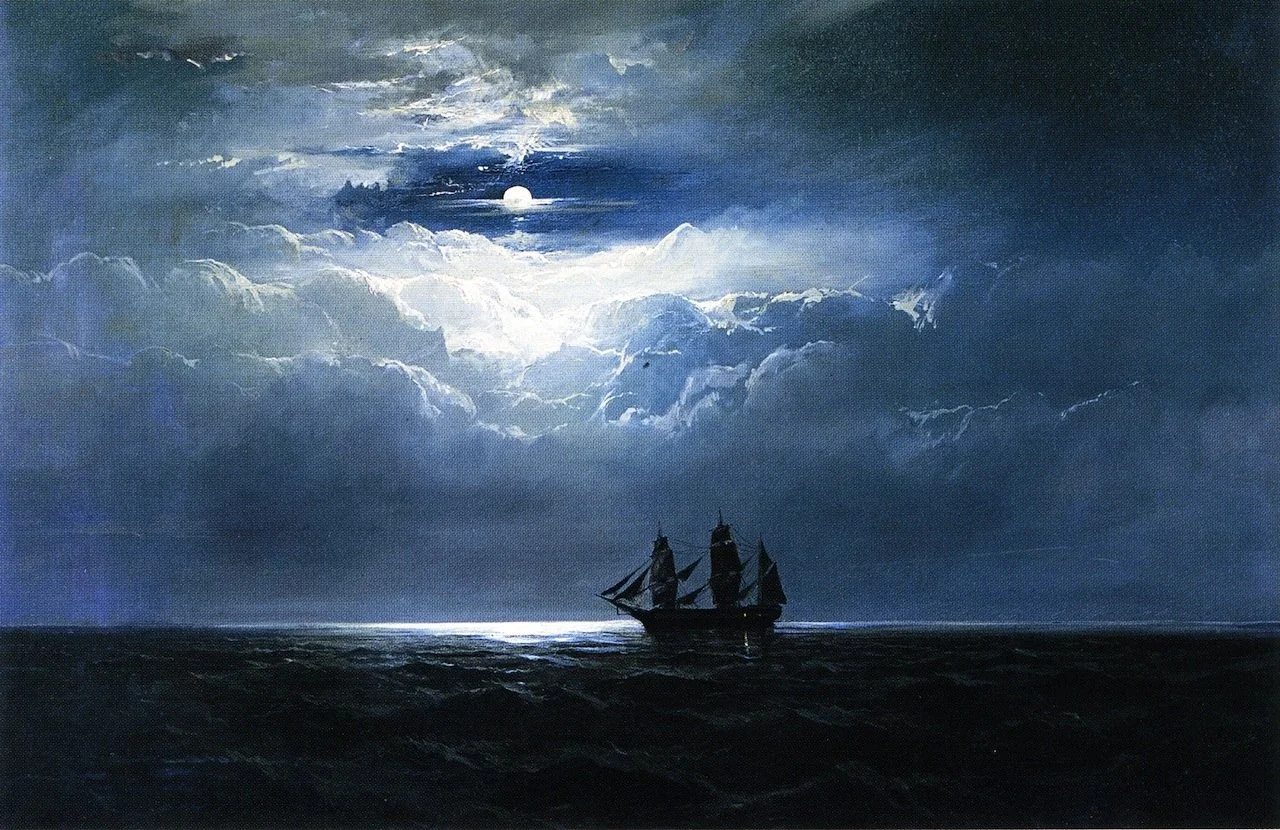
The Convict Ship, James Hamilton, 1864.
From the Retribution, John was transported to the Sir Godfrey Webster, a convict ship destined for Hobart Town. On 30 December 1823 after a voyage of 144 days—nearly five months—with a stop in Tenerife, 180 convicts were disembarked at Van Diemen’s Land, a colony entirely dependent on convict labour for its workforce.
Unlike many prisoners John seems to have adapted well to colonial life and within a few years he was working as a ‘javelin man.’ These were trustee convicts employed by the authorities as jail wardens, prisoner escorts, and guards at public hangings.
They were so named because they carried long, weaponlike wooden poles (javelins). Yet since they were recruited from the prison population, they were notoriously unreliable and susceptible to corruption—but still a cheap way for the colonial authorities to oversee their inmates.
By July 1827 John had been promoted to constable, a striking reversal for a man who had arrived under sentence of death only four years earlier.

The Hobart Town Gaol, 1838, where John likely worked as a Javelin Man and a Constable.
In 1826, while still a convict, he married fellow convict Lucy Falconbridge. He signed his own name on the marriage register, thereby leaving proof that he was literate, a rarity among transported laborers of his time and class.
The couple went on to have six children in Hobart, and during this time, in 1831 John received a Conditional Pardon. In 1838 he received a Full Pardon, fifteen years after his arrival in Van Diemen’s Land. The record noted that his character had been ‘most favourably reported by a Magistrate of his District.’
In the years that followed John worked as a painter and from 1835 as a licensed hawker and carrier, peddling goods through the streets of a colonial Hobart Town still under construction.
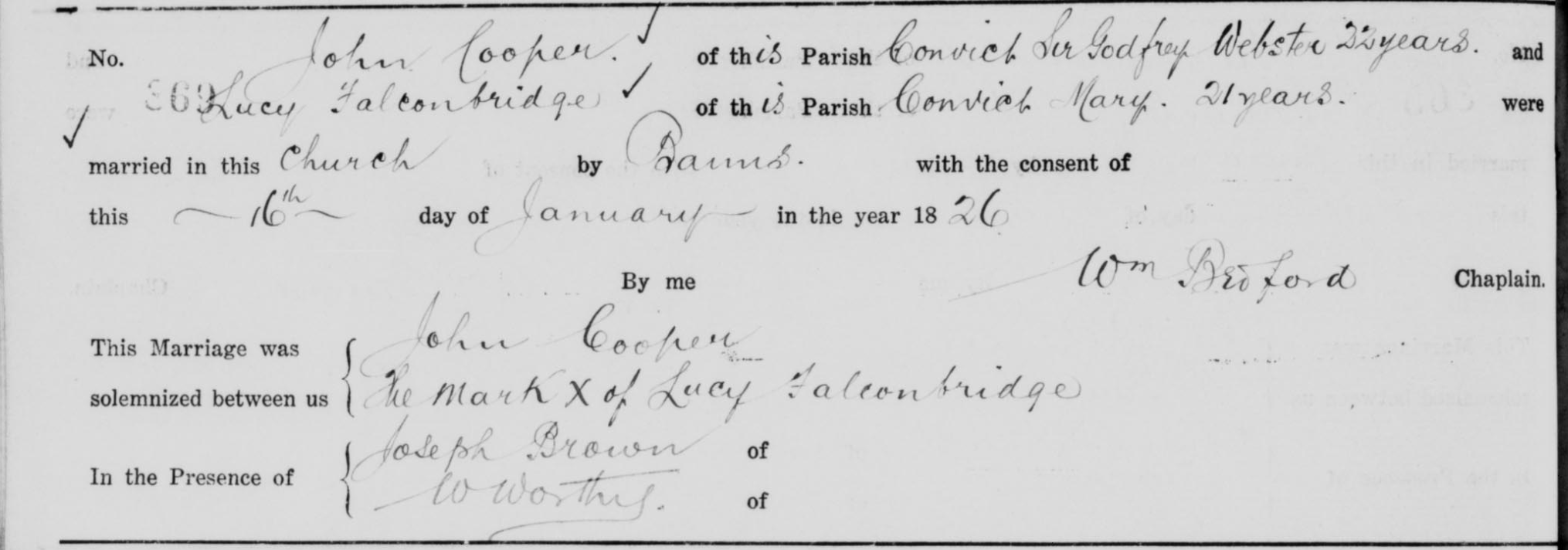
But the same economic precariousness that had shaped his early life in industrial Lancashire seems to have followed John to the end. He died, by the most reliable record, on 28 July 1888 at the New Town Pauper Establishment near Hobart—a workhouse-style institution for the destitute. He was around eighty-three years of age. His occupation was given simply as ‘Labourer’ and his cause of death recorded as ‘Senility.’
Here was a man who had once been sentenced to hang for highway robbery, who had risen to become a prisoner-constable, and wrangled a licensed trade, and who was finally pardoned as a free settler at the age of thirty-three while father to at least five dependent children.
Yet he ended his very long life exactly where so many of Britain's industrial poor did whether they emigrated or stayed home: dependent on institutional charity, particularly in old age.
It was a century that had built extraordinary new wealth in places like Salford's cotton mills. But such wealth inevitably led to extraordinary income inequality, which in turn led the once-gainfully so many went to live out the barest of their sad existences.
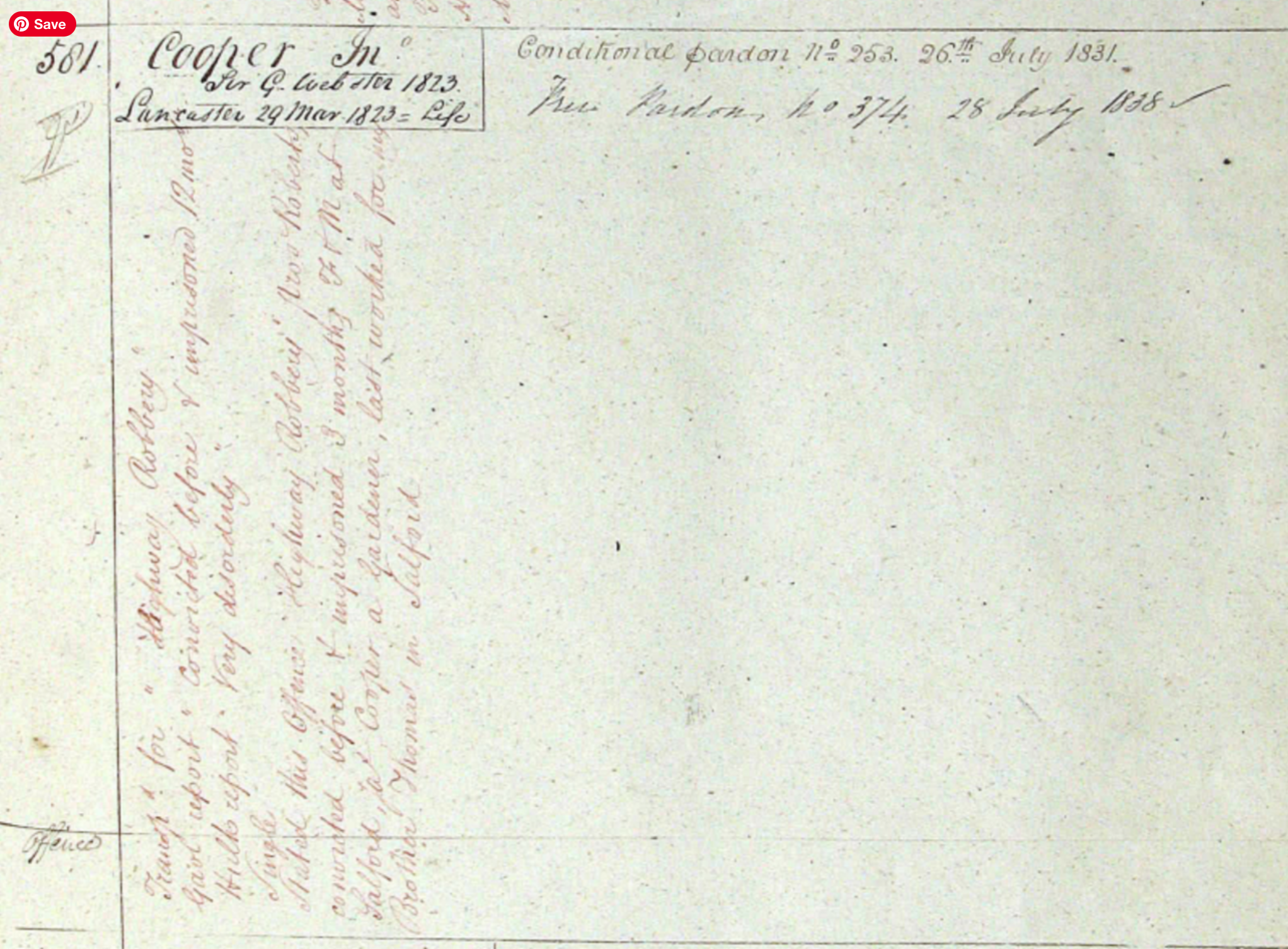
John Cooper’s convict record.