James Eates: An Orphan & a Soldier of the East India Company (1821-1857?)
Second great grandfather to Patience Jewell Whitty
James Eate was born on 3 July 1821 in Berhampur, in the Bengal Presidency, the son of Sergeant William Eate of the 17th Regiment of Foot and an unknown, unnamed mother. On his baptism register his birth is listed as ‘illegitimate,’ a designation given to Eurasian children in India whose mothers were Indian, or Eurasian themselves, regardless of their actual marital status.
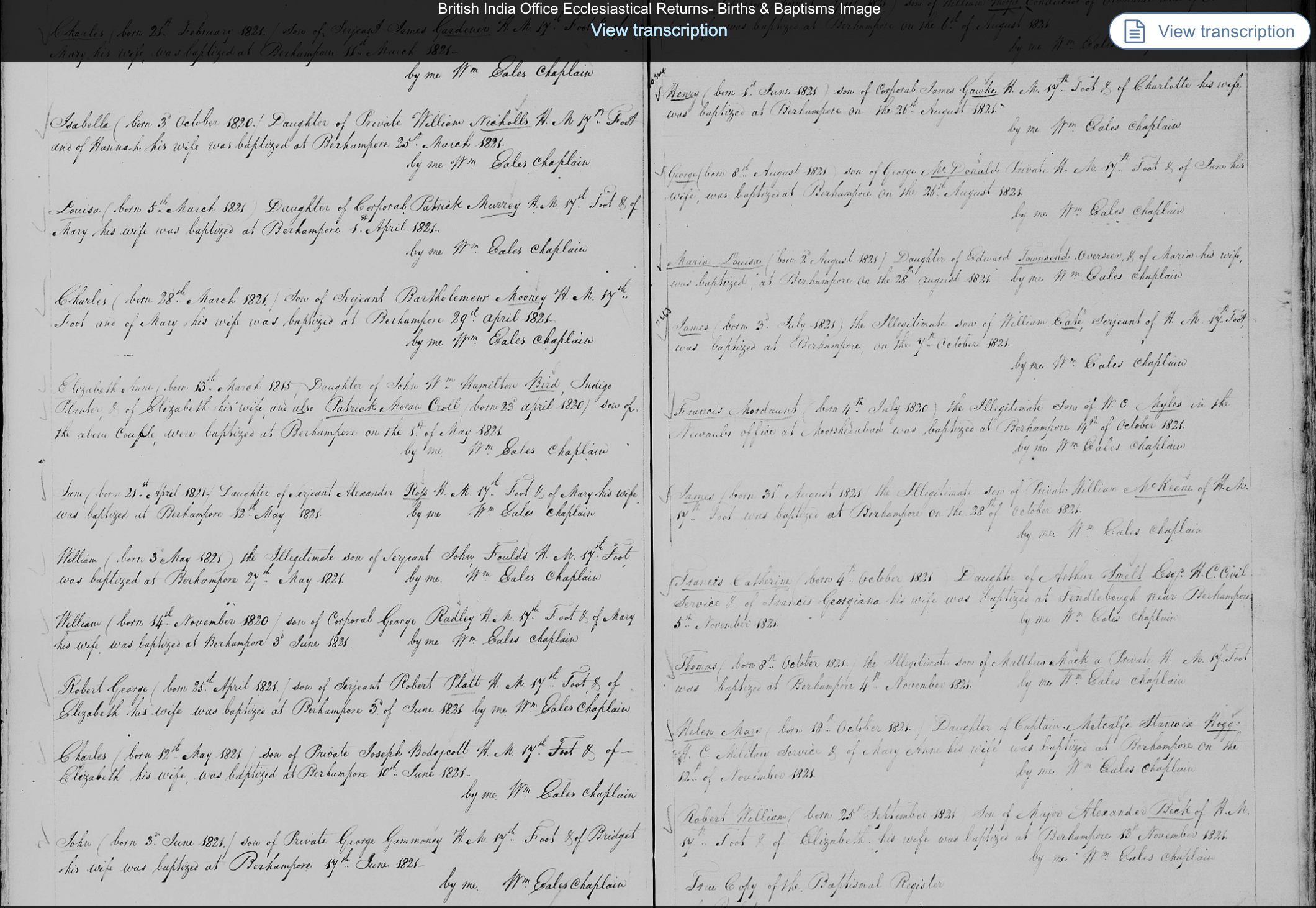
James’ baptism register (2nd page, 4th entry), where he is listed as the illegitimate son of William Eate.
What happened to James as a child follows a well-documented institutional path. Evidence from his sister Elizabeth's marriage record—which names her guardians as being the Head Master and Head Mistress of the ‘L.O.S.,’ the Lower Orphanage School in Kidderpore, just outside Calcutta—points to James having been raised at the same institution. Somewhere there his surname became ‘Eates.’
These orphan schools existed specifically to absorb the Eurasian children of British officers and troops and East India Company officers. The children were taken away from their Indian mothers somewhere around age five and whisked off to the orphanage schools to be raised as English speaking Christians (also to speak their mothers’ languages), which few British ever learned, and to be taught reading, writing, and arithmetic.
Ultimately this was a better schooling than many of the their British counterparts received at that time. However the orphanages were notorious for their high child mortality rate.
In these orphanage schools the boys were trained as military musicians—drummers, fifers, and trumpeters—or as medical assistants—apothecaries and medics. They began working as early as age thirteen, using military music to convey orders to the troops in the loud chaos of battle. The girls were married off at astonishingly young ages—as young as twelve—to older graduates of the same system. It was a self-perpetuating institutional machine.
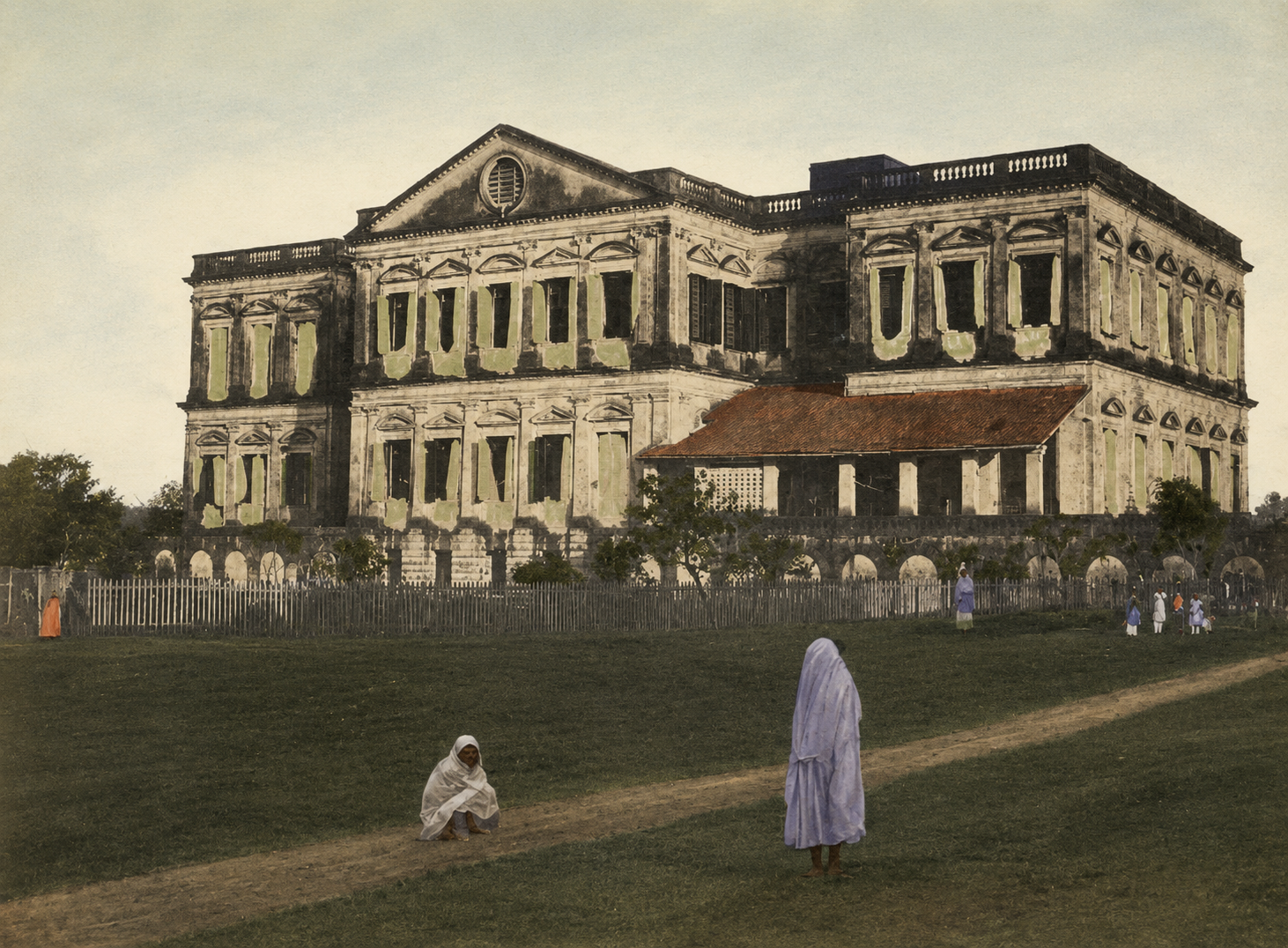
Military Orphanage School in Kiddepore near Calcutta. It’s uncertain if this is the Lower Orphanage School where James, as the son of a non-commissioned British officer went, or the Upper Orphan School, where the children of British officers went. (Are those gravestones behind the low fence?)
James followed that path too. On 25 June 1839, at Chunar, a garrison town on the Ganges, seventeen-year-old James wed sixteen-year-old Elizabeth Ryper, likely herself also a product of the same orphan-school system. Seventeen was young for a male to marry. Perhaps this wasn’t an arranged marriage but a shotgun wedding, though James and Elizabeth’s first surviving child wouldn’t arrive for several years.
At the time of the wedding James's occupation was recorded as Drummer with the 50th Native Infantry, a regiment of the East India Company’s Bengal Army. Military bandsmen were almost entirely Eurasian within this system—another example of the narrow niche colonial society carved out for a community it depended on but never fully absorbed.
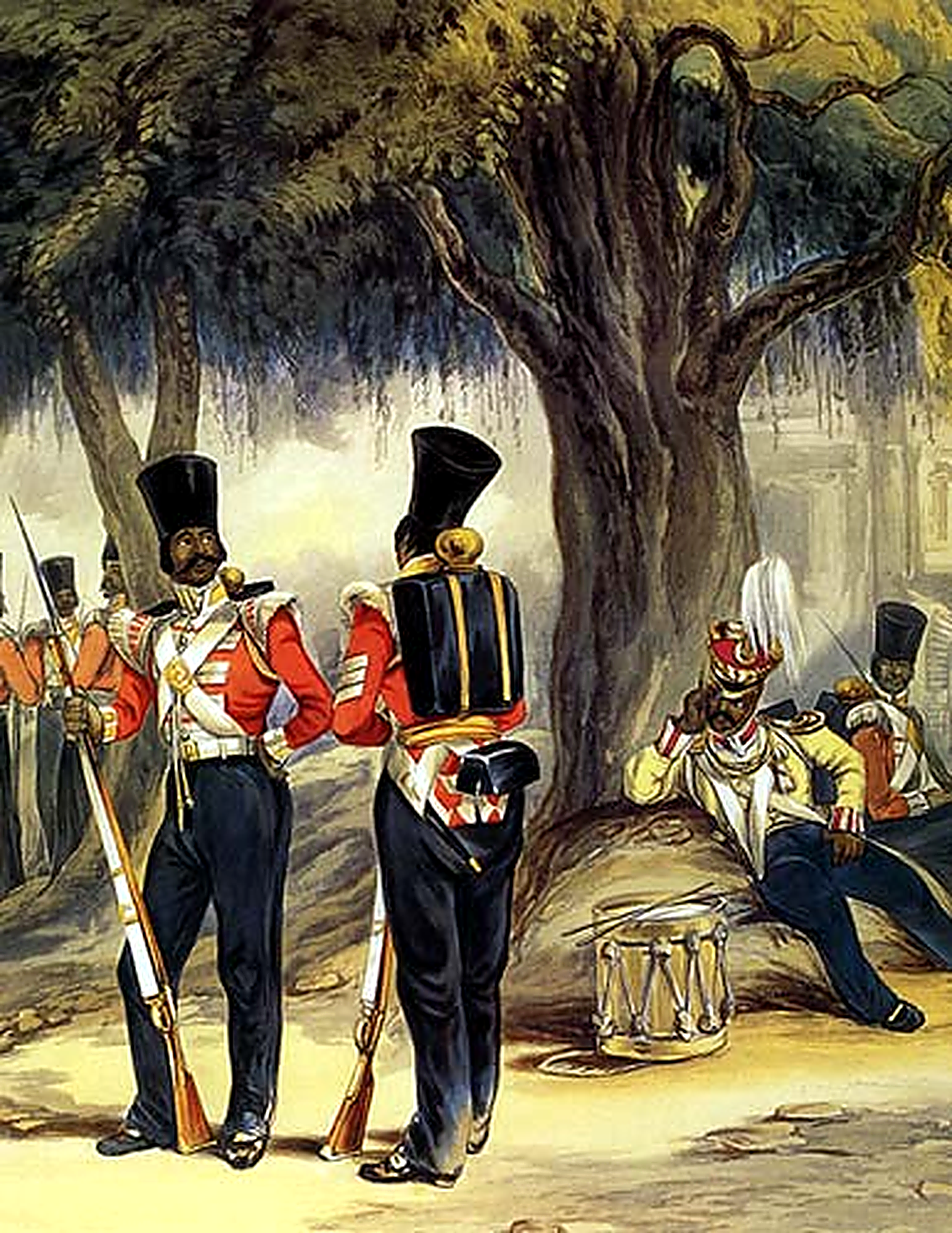
Eurasian drummer (seated) with the Bengal Native Infantry.
James and Elizabeth had at least five children together—George James, Alfred Birthright, Ernest William, Amelia, and William—the last of whom was baptized in 1852.
At that point James had risen to Fife Major with the 15th Regiment of Loodianah, better known as the 15th Ludhiana Sikhs. Fife Major was the highest rank a Eurasian bandsman could realistically attain. For James it represented two decades of steady advancement from an orphan school drummer boy to a senior position within his regiment's musical establishment.
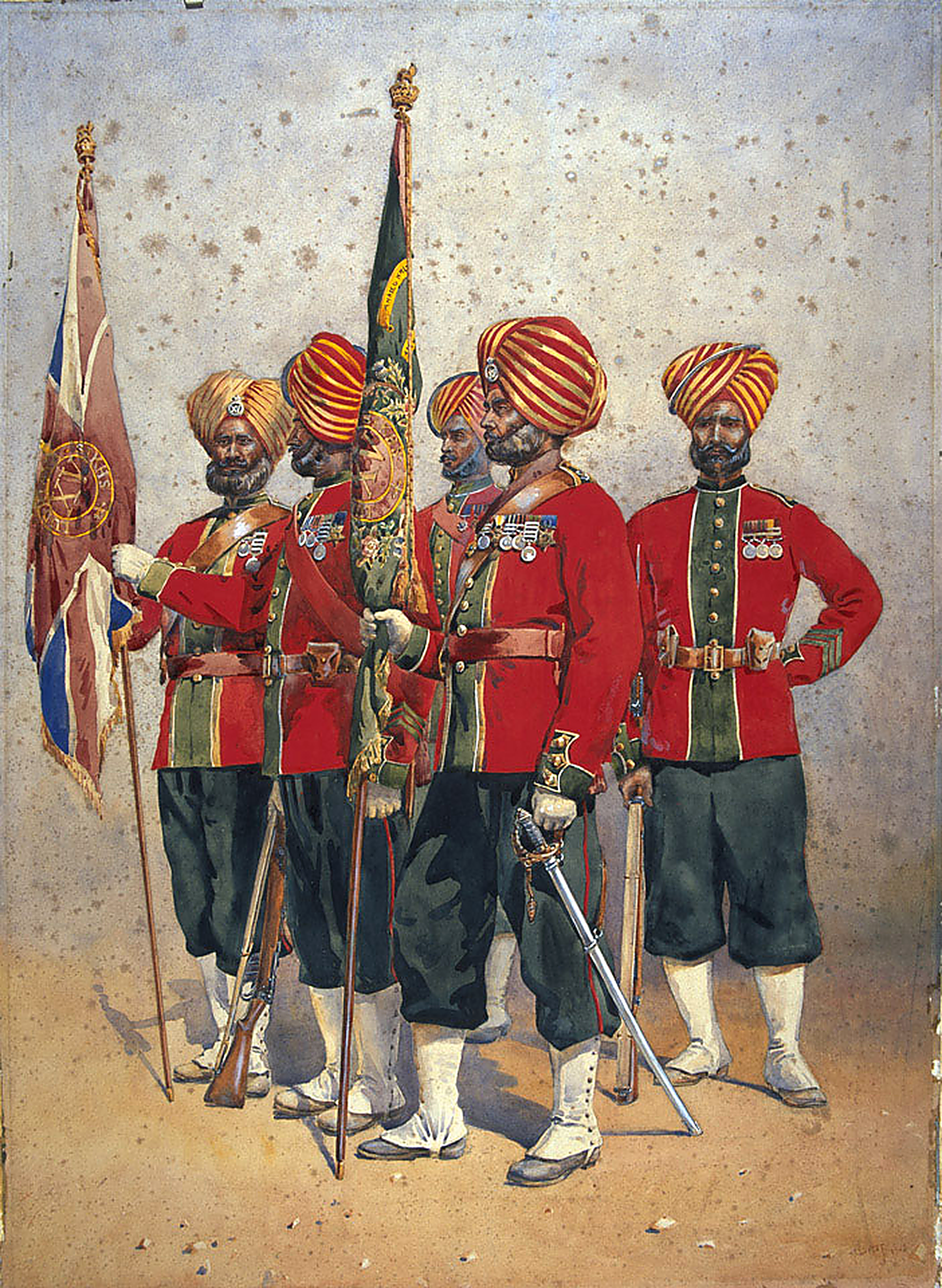
15th Ludhiana Sikhs.
And there the documented trail runs out. Neither James nor Elizabeth appears in any record after 1852. The silence is suggestive given what came next. James's last known regiment, the 15th Ludhiana Sikhs, was stationed at Benares when the Indian Rebellion/Mutiny reached the city on 4 June 1857. An account of the situation from The Families In British India Society reads:
“News of the Mutiny at Azimguhr reached Benares and it was decided that the 37th Bengal Native Infantry should be disarmed. Lieut Col James Neill had arrived from Madras with the 1st Madras European Regiment and insisted that this should be done at once. When called on parade some of the 37th came with arms and fired at their officers. The Sikh Infantry, thought to be loyal, also turned on the Europeans as did the Irregular Cavalry. Neill drove the rebels from their lines and withdrew into barracks for the night. Next day he consolidated his position and secured the treasury. The 37th fled from the cantonments during which about 100 were killed and 200 wounded. Further reinforcements ensured the safety of the Europeans and in subsequent days Neill carried out numerous hangings of suspected rebels as a deterrent.”
By every account this was one of the more violent and chaotic flashpoints of the Rebellion's opening weeks. James's own regiment was standing in the middle of it, while he himself, as a relatively high-ranking officer, would have been extra vulnerable to attack.

The Sepoy Revolt at Meerut, 1857, The London Illustrated News, 11 July 1857.
Eurasians as a community generally remained loyal to the British throughout 1857, but that loyalty offered little real protection. They were regarded with suspicion by both sides, British and Indian, and were trusted by neither, safe with neither, and killed by both as a result.
Were James and Elizabeth Eates among the casualties at Benares in 1857, along with their youngest child, who likewise disappeared around this time? Or did they simply vanish from a documentary record that was itself disintegrating under the weight of rebellion? Likely they arrived at the wrong time and place, when the entire colonial order was breaking violently apart—and the record, like so many thousands of lives on all sides in 1857, simply stops.
The East India Company Armies eventually ‘won,’ but just barely. And their reprisals against the civilians of India were horrific, with an estimated 100,000 to 800,000 killed, and thousands of villages and farms razed or set to fire. Forty to fifty thousands Indian troops were killed or executed afterwards. About 6,000 of 40,000 Europeans died. No one counted the Eurasians.