Joel Simcox: Potter, Soldier of Empire, & Murderer (1873-1935)
Grandfather to Patience Jewell Whitty
Joel Simcox was born on 21 April 1873 in Longton, Staffordshire, the heart of the district known as The Potteries, renowned for the its ceramics and porcelain and for the most polluted air in Britain in an era of intense industrialized coal-fired air pollution. Joel was the son of James Simcox and Mary Farmer Simcox, both pottery workers—as was Joel from an early age.
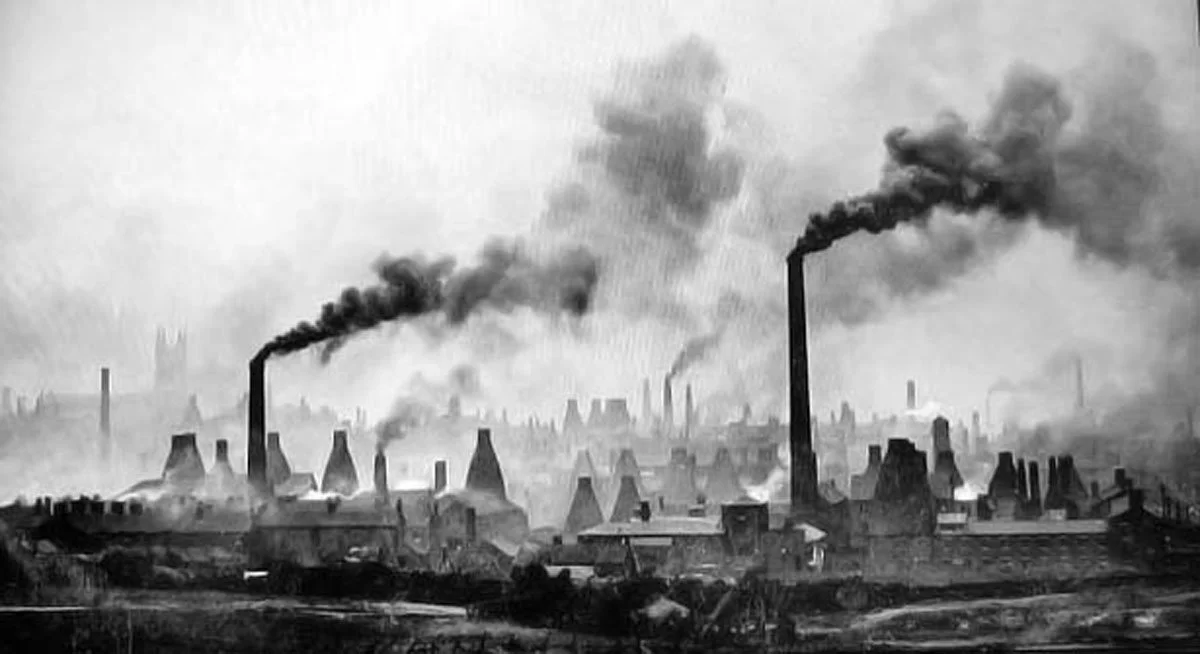
The Potteries, with dozens of coal-fired kilns producing copious amounts of air pollution, with Longton reputedly the most polluted town in Britain.
Like many working families of the period, the Simcoxes didn't rush individual children to the baptismal font. Joel was baptized in a job lot alongside his brother Ephraim and sister Eliza Jane on a single day in December 1887—evidently once the family got around to it.
His father died in January 1890, and by the 1891 census eighteen-year-old Joel was already working as a potter's assistant, one more pair of hands in an industry that had defined Longton for generations.
But he didn't stay in the pottery trade. Around March 1892 Joel enlisted in the North Staffordshire Regiment on a standard twelve-year engagement—seven years with the Colours, five in reserve. He trained at the regimental depot in Lichfield before joining the 2nd Battalion at Portland, then Portsmouth, and finally sailing in 1893 to join the 1st Battalion in Malta.
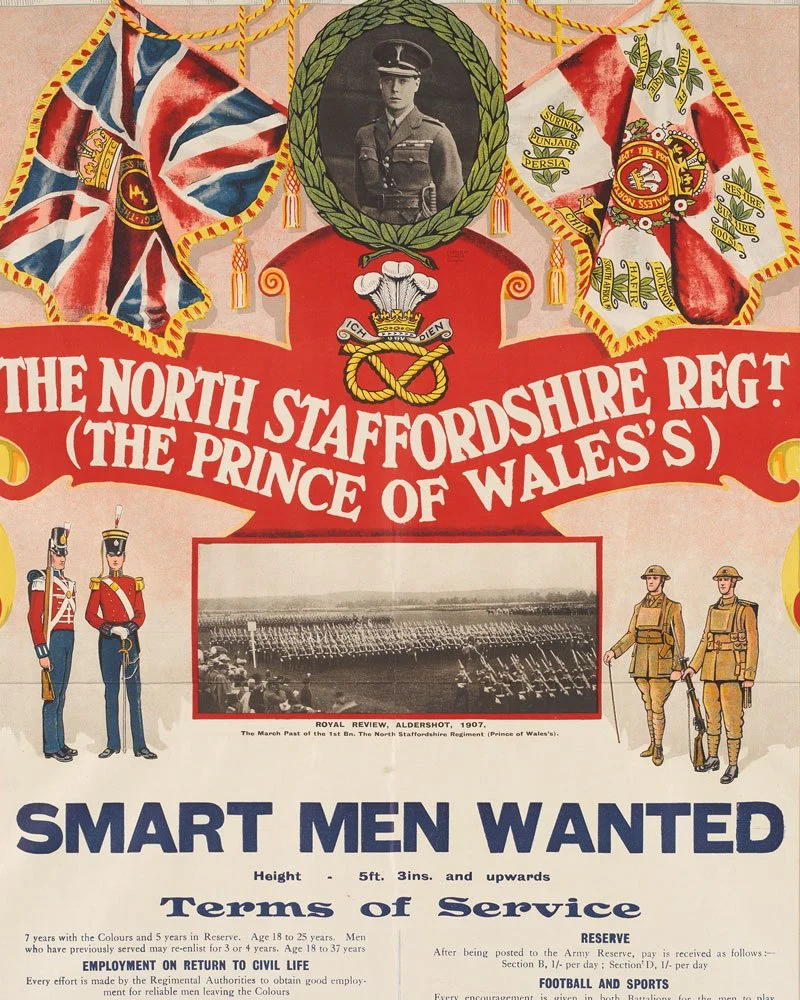
Recruiting poster for the North Staffordshire Regiment in 1907.
From there, his regiment was swept into one of the defining colonial campaigns of the era. in 1895 the 1st Battalion moved to Egypt, and in 1896 took part in Kitchener's Dongola Expedition, the opening phase of the Anglo-Egyptian reconquest of Sudan.
Joel was present for the bloody engagement at Farka in June 1896, where Egyptian forces killed roughly 800 Mahdist soldiers, as well as for the grinding advance up the Nile that followed—a campaign shaped by the cholera that killed over 900 of Kitchener's men that summer more than by the combat itself.
For his service, Joel received the British Sudan Medal and the Khedive's Sudan Medal with the ‘Hafir’ clasp, marking operations along the Nile between Kerma and Dongola in September 1896.
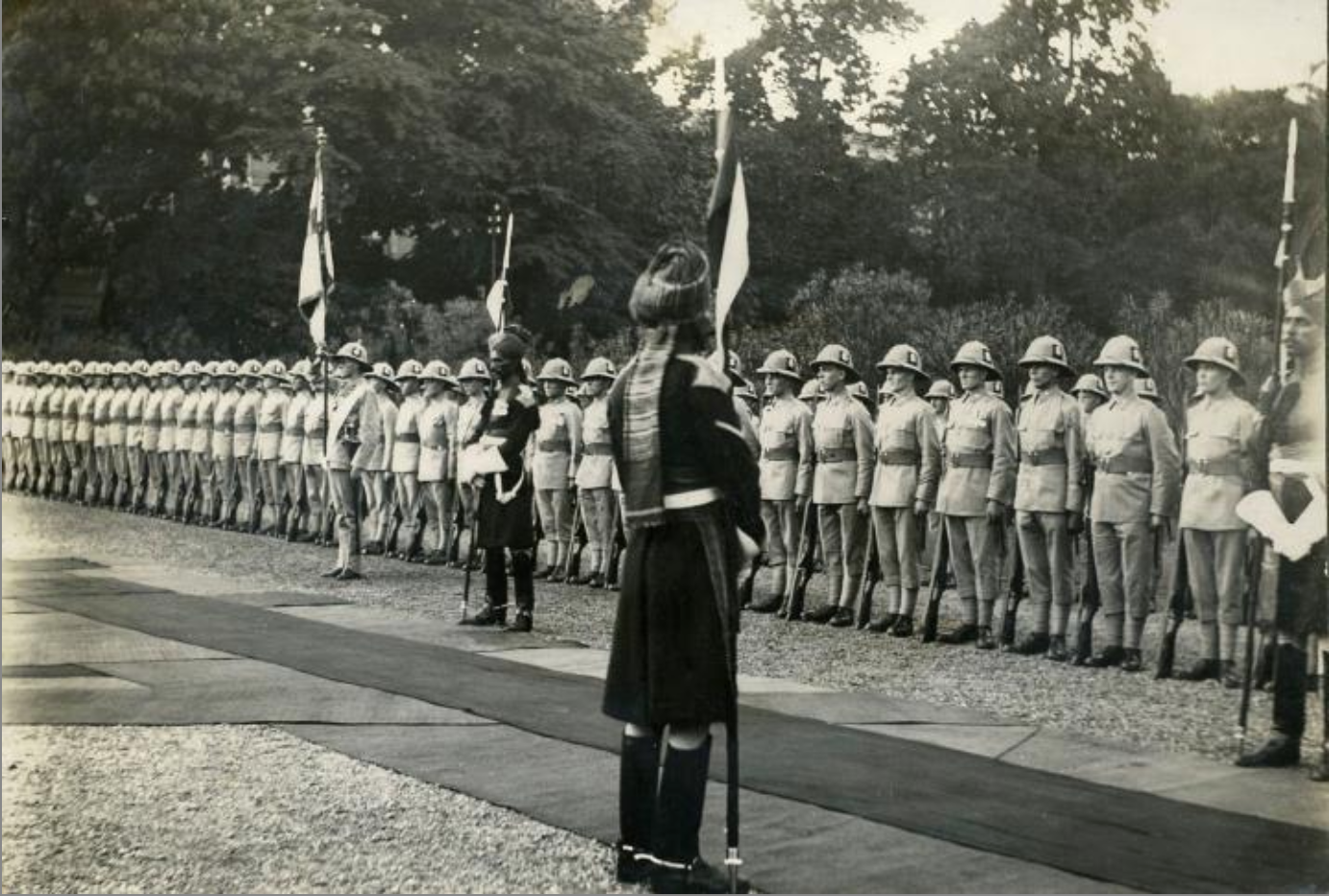
North Staffordshire Regiment in India, 1920s.
From Sudan, the regiment moved on to India, where Joel's own service record traces a familiar British Army circuit through the subcontinent's garrison towns and hill stations: Umballa, Subathu, Jutogh, Jhansi, Nowgong, and Cawnpore .
It was in Cawnpore where, on 25 September 1902, Joel married Helena Charlotte Eates—a fateful union between a British soldier and a Eurasian (by then known as Anglo-Indian) daughter of the Indian railways that would shape the lives of generations to come. Together they had two children, Julia Mary, born five months after the wedding, and Arnold.
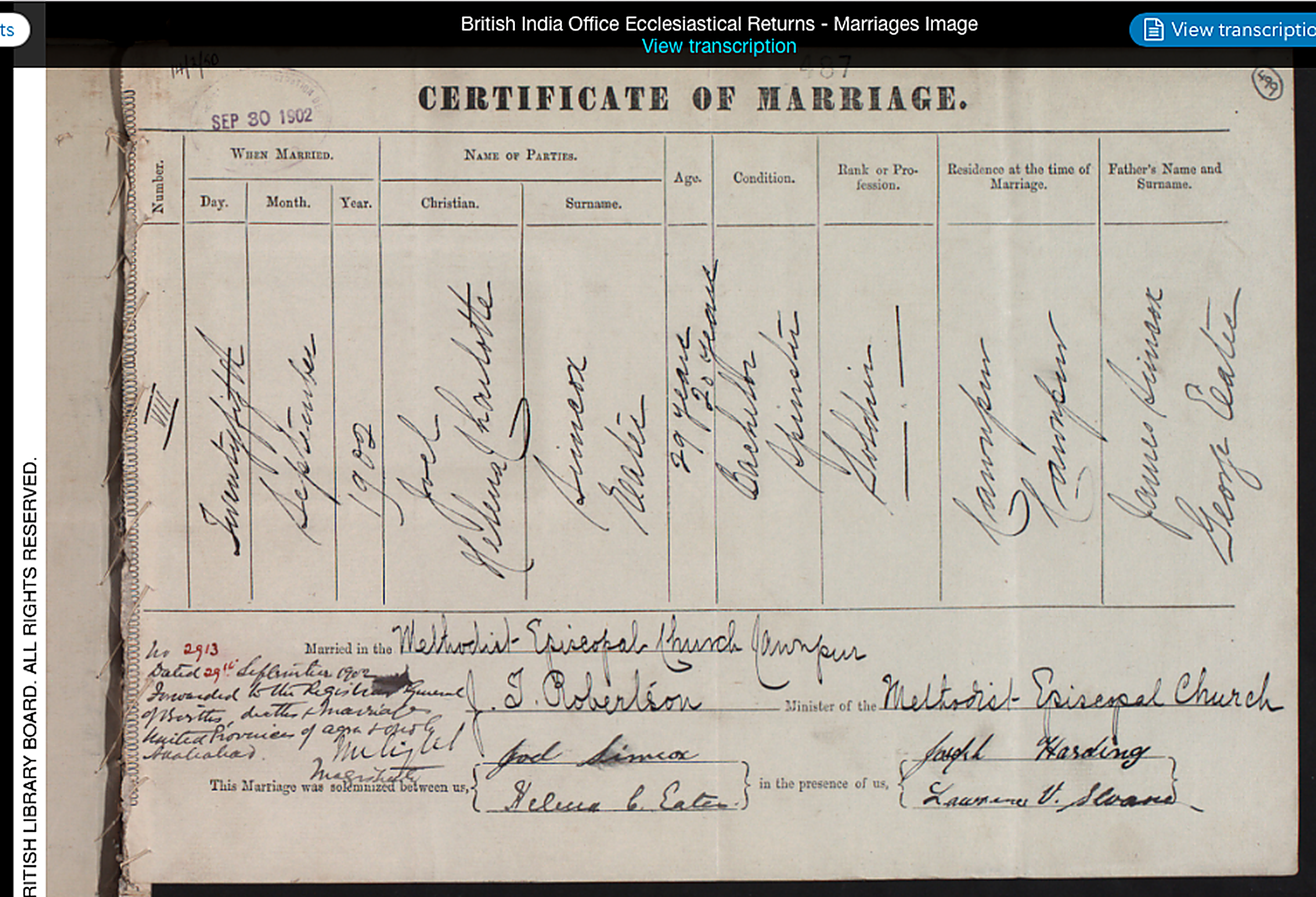
Marriage record of Joel Simcox and Helena Charlotte Eates.
When Joel’s battalion sailed home from Bombay in November 1903, he didn't go with it. Instead he took his discharge in India, going to work for the East India Railways at Asansol, where his father in law George James Eates worked, and where he likely helped Joel get the job.
What follows is a dark chapter in the family's history. According to the story passed down across four generations—from Helena's daughter Julia Mary Simcox, to her daughter Patience Jewell, to her daughter—Helena was murdered by Joel, who also killed their infant son Arnold, possibly on the same day. Three-year-old Julia Simcox, presumably in attendance of the murders, was taken in by an aunt and later sent a thousand miles away to be raised in the Woodstock School in Mussoorie in the foothills of the Himalayas.
Julia never knew who paid for this schooling, but wondered if it was her father, whom she spent the rest of her life trying and failing to track down.
The family account goes further still, claiming that the killings were covered up by Joel's former regiment, and that he was quietly spirited back to England and never brought to face any charges. Whether that protection came through old regimental loyalty, colonial indifference to violence against a soldier's wife, and a mixed blood wife at that, or simple administrative chaos in a remote railway town, the effect was the same—a double killing with no trial, no sentence, and no reckoning.
Where did Joel go? He was not present on the 1911 census in Britain and no records exist in India during these years after the murders. Perhaps he was whisked away to some outpost of Empire where the records were not saved?
He resurfaced in England for the First World War, where he re-enlisted in the North Staffordshire Regiment on 31 August 1914, almost certainly back in his home district around Stoke-on-Trent. From there he was later transferred to the Labour Corps in June 1917 after being judged unfit for further infantry service due to chronic bronchitis—possibly due, at least in part, to his early years in the intensely polluted area of The Potteries.
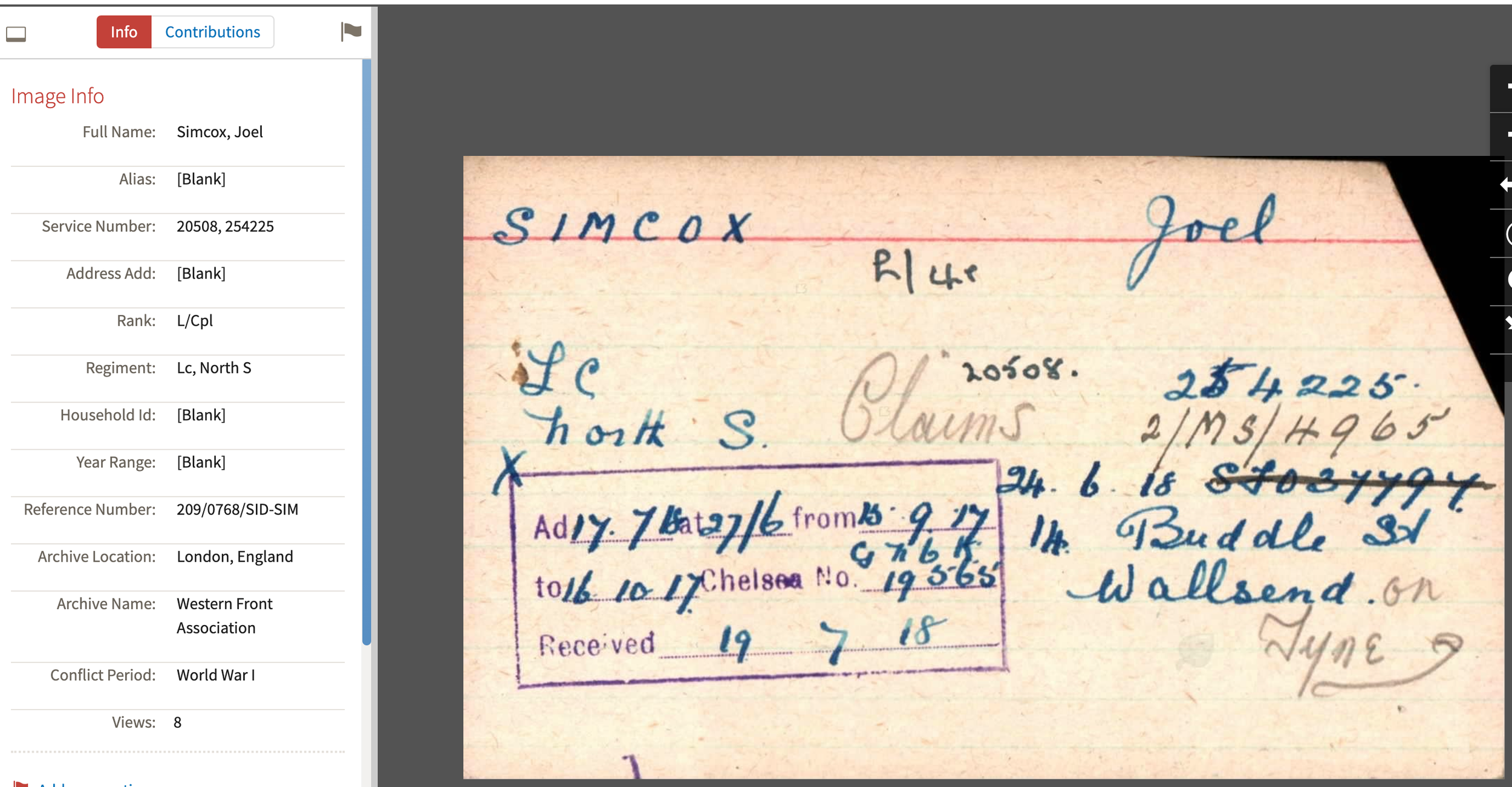
Joel’s World War One Pension Record Card 1918.
Notably his war service record shows no Medal Index Card—meaning that whatever campaigns he'd survived twenty years earlier in Sudan and India, the Great War itself he spent entirely on home soil.
He was likely assigned to a home-service dock-labour company in the North East. There he married for a second time in 1916, to Sarah Wightman in Tynemouth, Northumberland,. She was living in a workhouse there with her daughter, Ellen.
Joel was discharged from the army on 24 June 1918 on a pension for chronic bronchitis. He settled permanently in Wallsend-on-Tyne. The 1921 census shows him there still, fifty years old, living with Sarah and their two-year-old son Alfred George Simcox, alongside Sarah's teenage daughter.
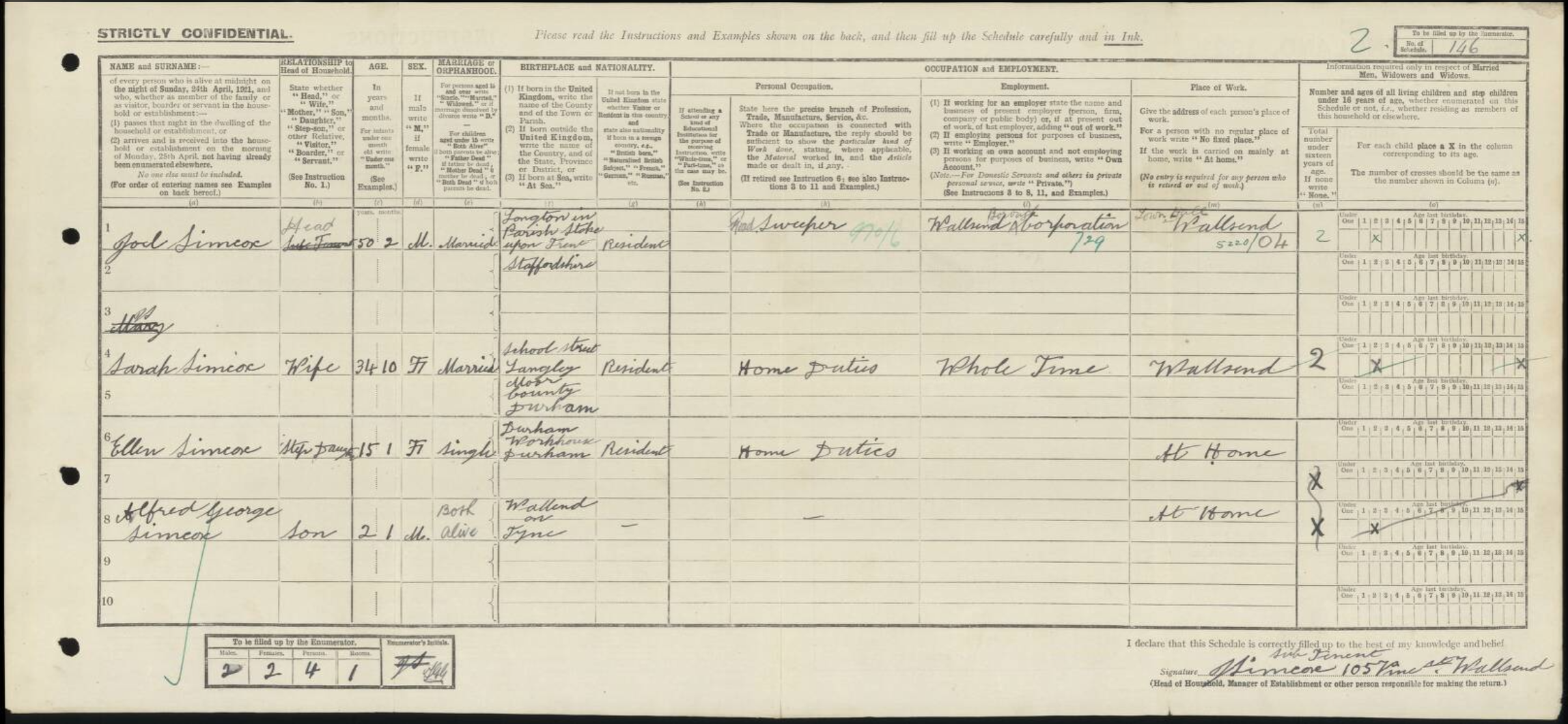
Joel Simcox and family 1921 British Census.
Joel Simcox died in April 1935 in Tynemouth, at age sixty-three. He had been a Potteries boy who had marched with Kitchener up the Nile, married and fathered children in British India, and walked away from the murder of his wife and infant son without ever answering for it in any court. Did he play any part at all in his daughter Julia’s life in India? He certainly never played any part in the lives of his six grandchildren born to her there.
Joel’s life was the starkest reminder of how thoroughly the machinery of Empire—its regiments, its postings, its capacity to move men quietly across continents—could also become the machinery of impunity.